

Whole House Air Purifiers in Glen Burnie, MD
Tario HVAC offers whole-house air purifiers for Glen Burnie homes, detailing exactly how these advanced systems integrate with your existing ductwork and HVAC equipment to deliver continuous, superior filtration. We cover common purifier types—True HEPA, activated carbon, UV, and hybrids—and the prevalent indoor air problems they effectively address, ranging from pollen and mold to VOCs and odors. Tario HVAC outlines crucial installation considerations, clear performance metrics, realistic testing expectations, and practical maintenance schedules, all designed to help homeowners like you confidently select, expertly install, and properly care for a system that genuinely improves air quality throughout your entire home.
.webp)
Whole House Air Purifiers in Glen Burnie, MD
Clean indoor air is critical for comfort and health in Glen Burnie homes. With humid summers, pollen from the Chesapeake Bay region, winter heating cycles that concentrate indoor pollutants, and occasional smoke or vehicle exhaust from nearby corridors, many families need a whole house solution that treats the air coming through the HVAC system—not just a portable unit in one room. Whole house air purifiers provide continuous filtration and contaminant reduction across every living space by integrating with your existing ductwork and HVAC equipment. Below we explain system options, how they work with duct systems, what they remove, testing and certification considerations, and realistic installation and maintenance expectations for Glen Burnie homeowners.
Common whole house air purifier types and how they help
- True HEPA systems
- Capture at least 99.97% of particles down to 0.3 microns, making them effective for pollen, pet dander, many fine particles, and smoke particulates.
- Best for allergy sufferers and homes where particulate removal is the priority.
- Activated carbon systems
- Adsorb gases, odors, VOCs from paints, cleaning products, and secondhand smoke.
- Useful in homes near busy roads or light industrial areas around Glen Burnie where fumes and odors are a concern.
- UV germicidal systems
- Use ultraviolet light to inactivate bacteria, viruses, and mold spores as air passes close to the lamp.
- Effective as a supplemental technology to reduce microbial load but not a replacement for filtration.
- Hybrid systems
- Combine HEPA, activated carbon, and UV elements to address particles, gases, and pathogens in a single in-duct unit.
- Offer the broadest protection for homes with multiple indoor air quality concerns.
Typical indoor air problems in Glen Burnie homes
- Seasonal pollen and mold during spring and damp months due to local vegetation and higher humidity.
- Increased indoor mold growth in basements and crawlspaces from humid summers unless ventilation and dehumidification are managed.
- Tobacco, cooking, and wildfire smoke particulates that can drift into the area periodically.
- VOCs and odors from household products and from nearby commercial or road sources.
- Older or leaky ductwork spreading dust and pollutants throughout living spaces.
How whole house systems integrate with HVAC ductwork
- Most whole house purifiers are installed in the return duct or at the air handler cabinet so filtered air is distributed by the furnace or air handler. Placement is critical for performance and accessibility.
- Proper sizing and static pressure calculations are required. High-efficiency filters and HEPA installations increase resistance to airflow; your HVAC blower must be able to handle the added load or a bypass/blower upgrade may be necessary.
- Duct sealing and cleaning before installation improves performance. Leaky ducts common in older Glen Burnie homes reduce system effectiveness and can reintroduce contaminants from attics or crawlspaces.
- Materials matter in coastal-adjacent environments. Salt-laden air and higher humidity can accelerate corrosion; choose housings and components rated for corrosion resistance when appropriate.
Performance metrics, testing and certification to expect
- Ask for documentation of filter efficiency and lab test results. For HEPA, the 99.97% at 0.3 micron standard is the benchmark. For VOC removal, third-party adsorption test data helps evaluate activated carbon capacity.
- Look for UV components that are UL listed or meet recognized safety standards for electrical and lamp containment.
- Whole house systems may not have CADR numbers like portable units, so request pre- and post-installation indoor air quality testing from an independent IAQ lab. Useful measurements include:
- Particle counts (PM2.5 and PM10)
- VOC levels and formaldehyde when suspected
- Mold spore counts and relative humidity
- Consider system designs aligned with industry ventilation guidelines such as ASHRAE 62.2 for whole-house ventilation and indoor air quality frameworks.
Installation expectations and common adjustments
- Professional assessment is recommended: load and airflow calculations, duct layout review, and compatibility check with your furnace/air handler.
- Typical installation locations: return duct near the air handler, plenum-mounted housings, or dedicated air cleaning modules. Access panels for filter changes and lamp replacement are standard.
- For homes with older HVAC systems, expect possible upgrades to blower motors or the addition of a bypass fan to maintain proper airflow with high-efficiency filtration.
Maintenance, replacement parts, and expected lifetimes
- Regular maintenance is essential to preserve performance and avoid airflow issues. Typical replacement intervals:
- Pre-filters and pleated filters: inspect every 3 months; replace every 6 to 12 months depending on load.
- HEPA filters: commonly replaced every 1 to 3 years, depending on runtime and particulate exposure.
- Activated carbon cartridges: replace every 3 to 12 months based on odor/VOC load and manufacturer capacity.
- UV lamps: replace annually or per lamp manufacturer life rating (often 9 to 12 months of continuous use) because UV intensity declines with time.
- Other parts: gaskets, access panel seals, and electronic controls may need periodic inspection and occasional replacement. Keep an eye on pressure drop across the filter housing; a rising pressure drop signals a clogged filter that reduces airflow and efficiency.
Practical benefits for Glen Burnie homeowners
- Reduced allergy and asthma triggers by removing pollen, pet dander, and fine particulates.
- Lower odors and fewer VOCs, improving comfort and indoor air safety when using cleaning products or paints.
- Decreased microbial loads with integrated UV, helping reduce mold spore viability and certain pathogens when combined with proper filtration.
- Whole-house coverage improves sleep and overall indoor comfort because treated air reaches every room and reduces hotspots of poor air quality.
Long-term care and sensible expectations
- Whole house purification complements ventilation, humidity control, and routine HVAC maintenance; it is not a single-answer cure. Controlling moisture, sealing and insulating ducts, and reducing pollutant sources inside the home will maximize the purifier’s benefits.
- Plan on routine inspections and a maintenance schedule tailored to your home environment. Homes near the bay or with high indoor activities may require more frequent filter changes.
- When evaluating systems, request lab-based performance data and plan installations that preserve HVAC airflow to avoid efficiency losses.
Whole house air purifiers deliver continuous, homewide air quality improvements when properly specified, installed, and maintained. For Glen Burnie households facing seasonal pollen, humidity-driven mold risk, smoke, or VOC concerns, integrated HEPA, carbon, UV, or hybrid solutions provide measurable reductions in particles, odors, and microbial load, improving health and comfort across every room.

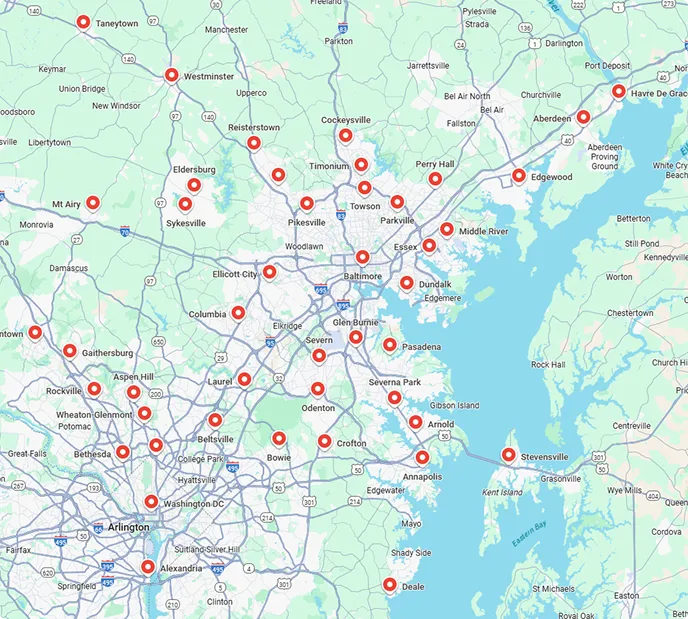
Service areas