

Whole House Air Filters in Glen Burnie, MD
Discover why whole-house filtration is so important in Glen Burnie, MD. We'll break down filter types, MERV ratings, how they affect airflow, optimal replacement schedules, and the crucial cost-versus-performance considerations. Tario HVAC empowers homeowners to select the best media cabinets, pleated, and activated-carbon options to dramatically improve indoor air quality, protect valuable equipment, and significantly reduce dust, pollen, and odors, all while smartly balancing energy use. We'll also cover practical maintenance steps, including monthly inspections during pollen seasons and appropriate replacement intervals, to help you sustain peak comfort, efficiency, and a healthier indoor environment. You'll experience noticeable improvements in your home's air quality and overall comfort.
.jpeg)
Whole House Air Filters in Glen Burnie, MD
Whole house air filters are a foundational upgrade for improving indoor air quality, protecting HVAC equipment, and reducing allergens in Glen Burnie, MD homes. With humid summers, seasonal pollen, and proximity to coastal air carrying salt and fine particles, selecting the right in-duct filtration system matters more here than in many inland locations. This page explains filter types, MERV ratings, how filters affect airflow and system efficiency, replacement schedules, HVAC compatibility, cost versus performance trade-offs, and the measurable indoor air benefits Glen Burnie residents can expect.
Why whole house filtration matters in Glen Burnie homes
Glen Burnie faces seasonal pollen, mold spores boosted by humid summers, and fine particulates from nearby roadways. Those factors increase airborne particles and put extra load on heating and cooling systems. A properly selected whole house filter:
- Reduces allergens such as pollen, dust mite debris, and pet dander
- Lowers airborne particulate matter including PM2.5
- Helps prevent dust and debris buildup inside ductwork and HVAC coils
- Improves overall comfort and can reduce cleaning frequency
Common whole house air filter issues in Glen Burnie
- Rapid clogging during spring pollen spikes or after home renovations
- Increased humidity-related mold growth on filters if not replaced or if system drainage is poor
- Reduced airflow and uneven heating or cooling when a filter is too restrictive for the system
- Confusion about MERV ratings and whether higher means always better
Whole house filter types and MERV ratings explained
Understanding filter media and MERV ratings helps match performance to your home’s needs.
- Fiberglass panel: Low initial cost, low resistance, basic dust capture. Best for protecting equipment where occupant allergy control is minimal.
- Pleated synthetic or cotton: More surface area, higher particle capture with moderate airflow restriction. Common residential choice.
- High-efficiency pleated (higher MERV): MERV 8 to MERV 13 capture fine dust, pollen, mold spores, and some smoke. Great for allergy-sensitive homes but may increase pressure drop.
- Media cabinet filters (deep-pleat): Larger surface area with lower pressure drop for higher efficiency ratings, good balance for many HVAC systems.
- Electrostatic filters: Use electrostatic attraction to capture small particles; available as disposable or washable types.
- Activated carbon media: Targets odors and some volatile organic compounds. Often used alongside particle filtration.
- In-duct HEPA or stand-alone HEPA systems: True HEPA captures 99.97 percent of particles 0.3 micron and larger but typically requires a dedicated in-duct housing or supplemental air cleaner due to high pressure drop.
MERV rating basics:
- MERV 1-4: Basic filtration, captures large particles
- MERV 5-8: Good residential filtration, standard comfort and equipment protection
- MERV 9-12: Better capture for allergy and finer particulates
- MERV 13-16: Near HEPA-level particle removal for medical or highly sensitive environments but can be restrictive for many residential systems
Selecting the right filter for your HVAC system
Choosing the best whole house filter is about matching filtration needs to HVAC capability.
- Check your furnace or air handler specifications for maximum recommended MERV or pressure drop. Many residential systems are designed for MERV 8 to 11 without modification.
- If you want MERV 13 or higher, consider a media cabinet or an upgrade to a variable-speed blower that can handle increased resistance.
- For homes with high humidity or mold concerns, choose filters that are less prone to moisture retention and ensure proper system drainage and condensation control.
- If odors or VOCs are a concern in Glen Burnie due to household activities or nearby sources, add activated carbon media in series with particle filters.
How filtration affects airflow and system efficiency
All filters introduce some resistance. The key factors are pressure drop and the filter’s surface area.
- Higher efficiency filters (higher MERV) remove more particles but typically create greater pressure drop. That can reduce airflow, forcing the blower to work harder and potentially reducing comfort or increasing energy use.
- Larger surface area filters, like deep-pleat media filters, minimize pressure drop while offering high capture efficiency.
- Dirty filters increase resistance rapidly. Regular replacement preserves airflow and prevents efficiency losses.
- For Glen Burnie homes where AC runs long in humid months, maintaining proper airflow is critical to avoid coil freeze-ups in winter and to ensure efficient cooling in summer.
Replacement schedules and filter maintenance
Filter life varies with filter type, home conditions, and season. Typical guidance:
- Fiberglass panel: replace every 1 to 3 months
- Pleated filters (MERV 8-12): replace every 3 months; check monthly during high pollen or renovation activity
- High-efficiency media filters: 6 to 12 months depending on thickness and home conditions
- Homes with pets, smokers, or renovation dust: expect shorter intervals, sometimes monthly
- Check filters visually; if the pleats are visibly clogged or airflow to registers is reduced, replace sooner
Maintenance tips:
- Inspect filters monthly during spring pollen and summer humidity
- Keep return vents and surrounding areas clean
- Ensure the filter is properly sealed and installed in the correct orientation
- Consider adding a pre-filter if you have frequent heavy dust to lengthen life of higher-efficiency media
Cost versus performance trade-offs
Higher MERV and specialty media deliver better air quality but typically cost more and may require system adjustments.
- Short-term cost: cheaper filters cost less upfront, but may need more frequent replacement and offer less particle capture.
- Long-term value: higher-performance filters can reduce dust in ductwork, protect HVAC components, and improve occupant health for allergy sufferers, potentially lowering maintenance and healthcare-related expenses.
- Efficient balance: for many Glen Burnie homes, a quality pleated filter rated MERV 8 to MERV 11 or a deep-pleat media filter gives the best mix of capture, airflow, and lifetime cost.
How proper whole house filtration improves indoor air quality
When selected and maintained correctly, whole house filters:
- Reduce allergens that trigger asthma and allergies
- Lower indoor particulate levels including PM2.5 from outdoor sources and cooking
- Minimize dust accumulation on furniture and inside ducts
- Protect HVAC coils and blowers from buildup that reduces system efficiency
In Glen Burnie, where seasonal pollen and humidity amplify airborne contaminants, good whole house filtration provides immediate, measurable comfort improvements and supports healthier indoor environments.
Final considerations and practical next steps
- Match filter efficiency to your household needs and HVAC capacity.
- Prioritize larger surface area filters or media cabinets if you need higher MERV without severe airflow penalties.
- Inspect filters monthly during high pollen and humid months and replace per the schedule suited to your home conditions.
- Combine particle filtration with odor control media if VOCs or odors are a concern.
Proper whole house filtration is a strategic investment for Glen Burnie homes: it balances comfort, equipment longevity, and health by reducing airborne contaminants while maintaining HVAC performance.

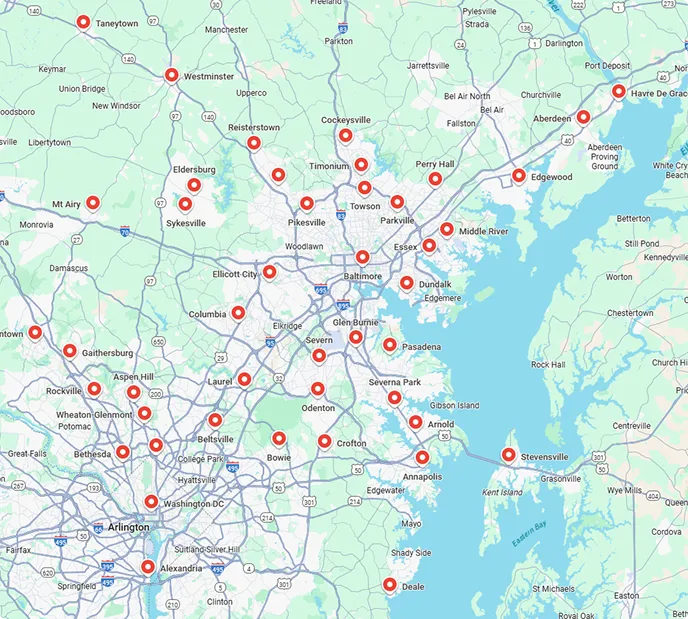
Service areas