

Whole House Air Purifiers in Halethorpe, MD
Explore Tario HVAC's whole-house air purifiers for Halethorpe, MD homes, detailing precisely how our integrated filtration improves indoor air quality, helps you select appropriate technologies, and perfectly matches your HVAC system. You'll learn about common challenges such as pollen, humidity, traffic pollutants, and VOCs; we compare true HEPA, high-MERV, activated carbon, UV-C, and ionizers; and help you understand expert installation, ongoing maintenance, and vital performance metrics. At Tario HVAC, our guidance emphasizes perfect system matching, regular filter changes, essential humidity control, and ongoing evaluation to significantly reduce allergy symptoms and asthma triggers across all seasons. We highlight practical steps for both homeowners and our professional installers, ensuring optimal results.
.webp)
Whole House Air Purifiers in Halethorpe, MD
Whole house air purifiers in Halethorpe, MD are a practical solution for homeowners wanting consistent, whole-home reduction of allergens, smoke, odors, and volatile organic compounds (VOCs). With Maryland humidity, spring pollen, and proximity to traffic and light industrial emissions around Baltimore and BWI, many Halethorpe homes benefit from in-duct purification that works with the HVAC system to clean the air in every room.
Common indoor air quality challenges in Halethorpe, MD
- Seasonal tree and grass pollen in spring and early summer increasing allergy symptoms.
- High summer humidity that promotes dust mites and mold growth in basements and attics.
- Traffic-related fine particulate matter and exhaust from nearby roads and commercial areas.
- Intermittent regional wildfire smoke transport, raising PM2.5 during distant fire events.
- VOCs from cleaning products, paints, and renovation projects common in older homes.
Understanding which pollutants are most concerning for your home guides the appropriate whole-house solution.
How whole-house air purifiers work with HVAC systems
Whole-house units are installed in the return plenum or ductwork and use the furnace or air handler airflow to circulate treated air through the living space. There are three common integration approaches:
- Passive in-duct filters that rely on HVAC blower to move air through HEPA or high-MERV media.
- Fan-assisted or bypass modules with their own fan to ensure adequate airflow and consistent filtration even when the system blower cycles off.
- Hybrid systems that combine media filtration, activated carbon, UV-C, or electronic collection inside an in-duct housing.
Proper installation considers existing blower capacity, static pressure limits, and duct sealing to maintain comfort and efficiency while achieving target clean air delivery.
Comparing technologies: strengths and limitations
- True HEPA / HEPA-grade media
- Strengths: Removes 99.97% of particles down to 0.3 micron, highly effective against pollen, dust, pet dander, and many smoke particles.
- Limitations: Standard HEPA cartridges are bulky for residential ducts; media can add pressure drop and may require fan-assisted models.
- High-MERV media
- Strengths: Easier to fit into many HVAC systems, captures a wide range of particle sizes.
- Limitations: Not all MERV filters capture the smallest particles as efficiently as true HEPA.
- Activated carbon
- Strengths: Adsorbs odors and many VOCs from paints, cleaners, and off-gassing materials; useful for smoke smell.
- Limitations: Capacity is finite; saturated carbon must be replaced regularly to remain effective.
- Ultraviolet (UV-C)
- Strengths: Inactivates bacteria, viruses, and mold spores when exposed directly; useful for protecting coils and reducing biological growth.
- Limitations: UV does not remove particles or gases; effectiveness depends on exposure time and lamp placement.
- Electronic precipitators / ionizers
- Strengths: Can capture very fine particles and reduce particulate load.
- Limitations: Some models produce low levels of ozone; require routine cleaning of collector plates.
Often the most effective whole-house approach uses combined technologies: a quality media filter (MERV 13 or better) or true HEPA for particles, plus activated carbon for VOCs and odors, with UV used selectively for biological concerns.
Selection criteria for Halethorpe homes
Choose a system based on:
- Home size and HVAC airflow: Match purifier capacity to your home’s square footage and system CFM to achieve desired air changes per hour (ACH).
- Primary pollutants: If allergies and pollen dominate, prioritize HEPA-level particle removal. For chemical odors or smoke, add activated carbon. For mold or frequent sick household members, consider UV.
- System compatibility: Verify your furnace or air handler can handle added static pressure, or opt for a fan-assisted module.
- Occupant sensitivities: Avoid electronic precipitators that produce ozone if anyone has asthma or chemical sensitivities.
Common targets: aim for 4 to 6 ACH for high-exposure situations (pollen season, wildfire smoke). For general comfort, 1 to 2 ACH combined with high-efficiency filtration reduces baseline exposure.
Installation and integration tips
- Site assessment: Measure duct layout, blower capacity, and return air locations. Install in the main return plenum where airflow is strongest for even whole-house coverage.
- Static pressure and blower tuning: Confirm the added filter or module will not exceed HVAC static pressure limits. Fan-assisted units often solve pressure problems without requiring major system changes.
- Duct sealing and balancing: Seal return leaks and balance supply registers to prevent short-circuiting and optimize distribution of filtered air.
- Commissioning: After installation, check system airflow, pressure, and verify improved particle counts if possible. Adjust runtime or fan settings for continuous low-speed operation to maintain steady filtration.
Maintenance and replacement schedules
- HEPA / media filters: Inspect every 3 months; replace typically every 6 to 12 months depending on load and local pollution. Higher pollen or smoke events may require more frequent changes.
- Activated carbon cartridges: Replace every 3 to 6 months for heavy VOC or odor control; less frequently in low-exposure homes.
- UV lamps: Replace annually or per manufacturer guidance to maintain germicidal output.
- Electronic precipitators: Clean collector plates monthly to quarterly depending on loading; follow manufacturer instructions to control ozone and maintain efficiency.
- HVAC coil and duct cleaning: Schedule coil cleaning and periodic duct inspections to prevent microbial growth that reduces system effectiveness.
Documenting maintenance dates and filter performance helps sustain air quality over time.
Performance metrics and expected health benefits
Key metrics to assess system performance:
- Clean Air Delivery Rate (CADR): Useful for room units; for whole-house focus on equivalent CADR per room or ACH.
- Air changes per hour (ACH): Higher ACH increases removal rate of pollutants.
- Particle removal efficiency: True HEPA captures 99.97% at 0.3 micron; high-MERV filters have graded efficiencies across sizes.
- Pressure drop: Lower is better for HVAC efficiency; balance filtration with system capability.
Health benefits for Halethorpe residents include reduced allergy symptoms (sneezing, itchy eyes), fewer asthma triggers from PM2.5 and irritant gases, decreased indoor smoke odor during regional fires, and lower overall exposure to VOCs. For families with asthma or severe allergies, continuous whole-house filtration can reduce nighttime symptoms by delivering cleaner air to bedrooms and living spaces.
Recommendations for allergy and asthma sufferers in Halethorpe
- Prioritize a true HEPA or high-MERV solution combined with activated carbon for pollen, pet dander, smoke, and VOC control.
- Maintain indoor relative humidity between 30 and 50 percent to limit dust mite and mold growth in Maryland’s humid months.
- Run continuous low-speed fan operation during peak pollen season and anytime outdoor smoke or high traffic pollution is present to maintain steady filtration.
- Ensure any electronic purifier is certified to produce minimal or no ozone to avoid aggravating asthma.
- Focus filtration on bedroom airflow and seal windows/doors during high pollen or smoke days to reduce infiltration.
Whole-house air purifiers installed and maintained to match Halethorpe home conditions provide measurable improvements in indoor air quality and symptom relief for allergy and asthma sufferers. Proper system choice, professional integration with your HVAC, and a disciplined maintenance routine maximize performance and health benefits across seasons.

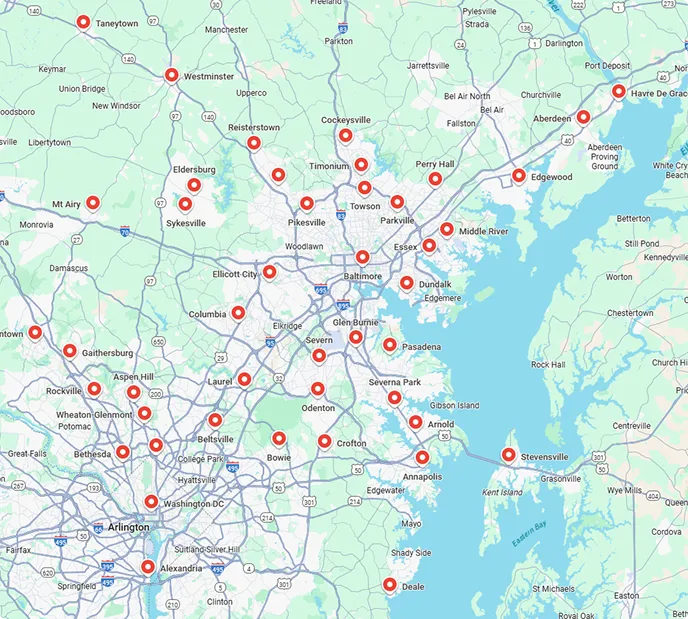
Service areas