

Whole House Air Filters in Annapolis, MD
For Annapolis homes, whole-house filtration is essential. At Tario HVAC, we explain how coastal humidity, pollen, and salt air affect indoor air quality and HVAC wear. We review different filter types, MERV ratings, and upgrade options available. Tario HVAC covers selecting filters based on specific concerns like allergies, dust, or smoke, as well as installation locations, replacement schedules, diagnostics, and maintenance. We discuss efficiency impacts, the benefits of professional upgrades, health advantages, and cost considerations to help you balance filtration performance with system compatibility. Our practical guidance on installation, maintenance, and cost tradeoffs empowers homeowners to plan upgrades that fit their budgets while effectively protecting their equipment.
.webp)
Whole House Air Filters in Annapolis, MD
Here at Tario HVAC, we know that cleaner indoor air begins with a smart whole-house filtration strategy. For Annapolis homes, coastal humidity, seasonal pollen, and the bay's salt air, combined with daily dust, pet dander, cooking particles, and even occasional smoke, can create air quality challenges that basic disposable filters just can't handle. Let's walk through your whole-house filtration options, how different filters impact your HVAC system's performance and lifespan, choosing the right filter for unique needs, replacement schedules, professional upgrade paths, maintenance advice, and the real-world cost tradeoffs for Annapolis homeowners.
Why whole house filtration matters in Annapolis, MD
- Coastal humidity encourages mold and dust mite growth, increasing biological contaminants inside homes.
- Bay breezes and seasonal winds carry pollen and fine dust into neighborhoods, raising allergen loads during spring and fall.
- Salt and coastal corrosion can accelerate HVAC wear when dust settles on coils and mechanical parts.
- Periodic regional smoke from distant wildfires or local burning can raise fine particle concentrations (PM2.5) that ordinary filters miss.
Whole house filters protect living spaces by treating the air as it circulates through the HVAC system. Proper filtration improves indoor air quality, reduces allergic reactions, lowers dust accumulation, and helps the HVAC system run more efficiently and last longer.
Common whole house filter types and MERV ratings
Understanding filter types and MERV ratings helps match performance to your needs.
- Fiberglass disposable (MERV 1-4)
- Pros: Low cost, very low airflow restriction.
- Cons: Captures only large particles; not effective for allergens or fine dust.
- Best for: Basic protection when allergens are not a concern.
- Pleated filters (MERV 5-11)
- Pros: Better particle capture for dust, pollen, and pet dander.
- Cons: Needs regular replacement; mid-level airflow restriction.
- Best for: Typical homes prioritizing dust and pet hair reduction.
- High-efficiency pleated (MERV 12-13)
- Pros: Captures smaller particles and many allergens; good balance of filtration and airflow for many systems.
- Cons: Higher initial cost and can load faster in dusty or smoky environments.
- Best for: Homes with allergy sufferers, nearby outdoor pollutants, or regular cooking/smoke exposure.
- Whole-house HEPA or media filters (MERV 14-16 / HEPA equivalent)
- Pros: Excellent capture of very fine particles, including most PM2.5 and many biological contaminants.
- Cons: Often require a dedicated media cabinet or HVAC modification; higher cost; potential airflow restriction if not paired with suitable equipment.
- Best for: Severe allergy/asthma issues or homes needing near-medical grade filtration.
- Electronic filters and washable electrostatic units
- Pros: Reusable, can capture small particles.
- Cons: Maintenance heavy, variable performance, and may produce ozone if poorly designed.
- Best for: Specific situations where reusable filters are preferred and maintenance is consistent.
- Carbon or activated-charcoal layers
- Pros: Reduce odors, VOCs, and some gaseous pollutants.
- Cons: Limited particle capturing; usually combined with another filter type.
- Best for: Houses with cooking odors, smoke smells, or chemical sensitivities.
Choosing the right filter for specific concerns
- Allergies and asthma: Aim for MERV 11-13 or whole-house HEPA solutions. In Annapolis, pollen season can spike allergen loads, so higher capture efficiency helps indoor air quality.
- Dust and pet dander: MERV 8-11 pleated filters are effective and balance cost and airflow.
- Smoke and PM2.5: Select high-efficiency filtration (MERV 13+ or HEPA) and consider adding a dedicated whole-house air purifier or portable HEPA units in living areas during smoke events.
- Odors and VOCs: Use a primary particulate filter plus a carbon stage to adsorb gases and odors.
- System compatibility: Check your HVAC manufacturer recommendations. Many residential systems can handle MERV 11-13 with minimal modification; MERV 14+ or true HEPA often require professional upgrades.
Installation, replacement schedules, and diagnostics
- Installation: Most whole house filters are installed at the furnace or air handler return plenum. Media cabinets and larger filter housings can be added for higher-efficiency filters.
- Replacement schedule guidelines:
- Basic fiberglass: replace every 30-60 days.
- Pleated MERV 5-11: inspect monthly, replace every 60-90 days.
- Higher-efficiency MERV 12-13: inspect monthly, expect replacement every 60-120 days depending on load.
- Media or whole-house HEPA: typically longer life between service intervals; follow manufacturer guidance and professional inspection.
- Local adjustments: In Annapolis, increase inspection frequency during pollen seasons, after renovations, or during smoke events. High humidity can also cause filters to load or trap biological growth earlier.
- Diagnostics: A professional can measure static pressure drop and airflow to verify that a chosen filter is not restricting the system. Visual inspection for visible dirt and airflow tests are effective home checks.
Professional upgrade options and impact on system efficiency
- Media filter cabinets: Allow use of higher-efficiency media without frequent replacement and with less airflow restriction than an oversized pleated filter.
- Whole-house HEPA integration: Requires a bypass or inline HEPA unit sized by HVAC airflow. Provides superior PM2.5 reduction but typically requires a licensed technician to install.
- UV-C and coil sanitization: Adding UV lamps near the evaporator coil reduces biological growth and improves coil efficiency, especially useful in humid Annapolis summers.
- HVAC tuning and duct cleaning: Combining filtration upgrades with preventive maintenance reduces dust load on coils and fan motors, improving efficiency and extending system life.
Effects on efficiency and lifespan:
- Clean, properly rated filters reduce fan energy by lowering restriction compared to dirty filters, maintain proper airflow through the evaporator coil, and prevent dust buildup on heat exchange surfaces.
- Oversized or overly restrictive filters can force the blower to work harder, reducing efficiency and potentially shortening motor life if the system is not compatible. Professional assessment balances filtration goals with system capacity.
Maintenance tips and cost considerations
- Inspect filters monthly during pollen season and after events that increase indoor particulates.
- Replace or clean filters before noticeable airflow reductions or when visibly loaded with dust.
- Keep return registers and grilles free from obstructions and vacuumed periodically to reduce dust entering the system.
- Pair filtration upgrades with annual HVAC maintenance and seasonal checks for humidity control and coil cleanliness.
- Cost tradeoffs: Higher-efficiency filters and media cabinets have higher upfront costs but can reduce long-term maintenance, protect HVAC components, and improve energy efficiency by keeping coils cleaner. Lower-cost filters need more frequent replacement and may allow more dust onto system components, increasing service needs.
Selecting the right whole house filter in Annapolis means accounting for coastal humidity, seasonal pollen, salt-laden air, and the specific indoor sources of pollutants in your home. Balance filtration efficiency with HVAC compatibility to protect equipment and maintain comfort. Professional evaluation is recommended when considering media cabinets, whole-house HEPA, or any upgrade above MERV 13 to ensure proper airflow, static pressure, and system longevity. With the right setup and routine maintenance, whole house filtration provides cleaner air, fewer allergens, and a healthier, more efficient HVAC system suited to Annapolis living conditions.

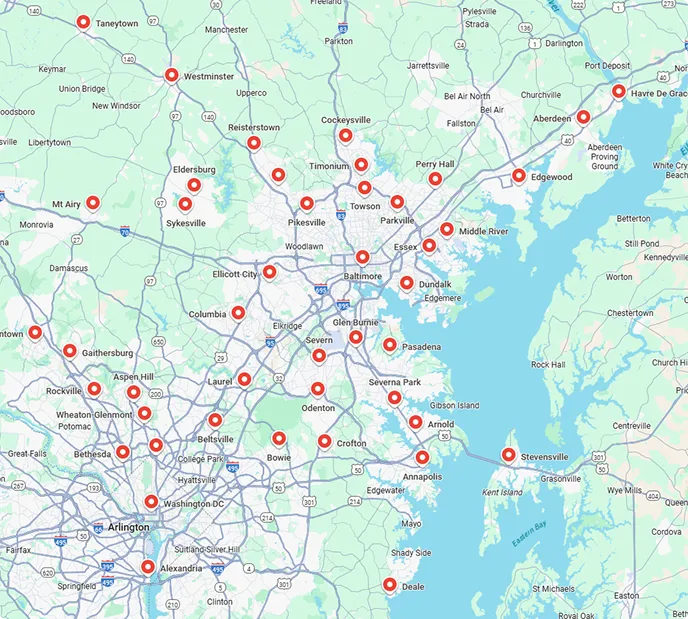
Service areas