

Ventilation in Rockville, MD
Rockville, Maryland homeowners can dramatically enhance comfort, indoor air quality (IAQ), and energy efficiency with a custom-tailored ventilation strategy. Tario HVAC understands why proper ventilation is crucial during humid summers, pollen seasons, and in older homes. We describe common solutions like whole-home systems, HRVs, ERVs, and targeted spot ventilation. Our service covers a comprehensive assessment, ensuring code compliance, meticulous design, precise installation steps, system balancing, and ongoing maintenance. We then explain how improved ventilation effectively reduces humidity, odors, and allergens, providing safer, more consistent indoor air year-round. For reliable results, a professional assessment is always the first step.

Ventilation in Rockville, MD
Proper ventilation is one of the most effective upgrades you can make to improve comfort, reduce odors, and protect your home from moisture and indoor air pollutants. In Rockville, MD, where hot, humid summers, cold winters, and seasonal pollen combine to challenge indoor air quality, a tailored ventilation strategy — whether whole home or targeted spot ventilation — is essential for healthy living spaces and long term durability.
Why ventilation matters in Rockville, MD homes
Rockville experiences high summer humidity, spring and fall pollen spikes, and older housing stock that may lack modern mechanical ventilation. These local factors increase the risk of:
- Elevated humidity and condensation in basements and attics, which encourages mold and structural decay
- Persistent allergens and cooking or pet odors lingering indoors
- Stale air in tightly sealed, energy efficient homes without adequate fresh air exchange
- Energy loss from uncontrolled ventilation if systems are not designed or balanced correctly
A properly designed ventilation system improves indoor air quality (IAQ), controls moisture, reduces allergens and odors, and can do so while minimizing energy penalty when using energy recovery technologies.
Common ventilation solutions for Rockville homes
Understanding the options helps homeowners choose the right solution for their needs and local conditions.
- Whole-home mechanical ventilation: Continuous systems sized to meet standards like ASHRAE 62.2 that deliver balanced fresh air to the entire house.
- HRV (Heat Recovery Ventilator): Best for colder months; transfers heat between incoming and outgoing air to reduce heating load while providing fresh air.
- ERV (Energy Recovery Ventilator): Better where humidity control matters; transfers both heat and moisture to moderate incoming air and reduce moisture load in humid summers.
- Spot ventilation: Targeted exhaust fans for kitchens, bathrooms, laundry rooms, and garages to remove contaminants at the source.
- Supply-only and exhaust-only options: Sometimes used in specific scenarios, but balanced systems with recovery are generally preferred for energy efficiency and humidity control in Rockville climate.
- Ducted vs ductless ventilation: Ducted systems connect to the central HVAC for distribution; ductless or in-line fans serve localized needs.
Typical ventilation problems in Rockville and what causes them
Identifying the root cause leads to effective fixes.
- High indoor humidity and mold: Poor exhaust in bathrooms, insufficient whole-house exchange, or crawlspace/basement moisture intrusion.
- Persistent odors and VOCs: Lack of source ventilation in kitchens, garages, or workshops; inadequate fresh air dilution.
- Uneven ventilation and dead zones: Poorly designed distribution or blocked ducts leading to stagnant rooms.
- Energy waste: Overventilation or unbalanced systems that bring in more outside air than required, increasing heating and cooling loads.
- Code noncompliance: Older homes or DIY installations may not meet Montgomery County or Maryland ventilation and energy code requirements.
Assessment and code compliance checks
A proper ventilation project begins with a detailed assessment specific to Rockville homes.
- Onsite inspection of existing ventilation fans, ductwork, air leakage, and moisture sources.
- Whole-house ventilation rate calculation using square footage, occupancy, and applicable standards such as ASHRAE 62.2 and local codes.
- Moisture and IAQ diagnostics including humidity logging, visual mold inspection, and possibly basic pollutant testing.
- Code review for Montgomery County and Maryland requirements to ensure systems meet current ventilation and energy standards.
Design and installation process
Design should balance IAQ, comfort, and energy efficiency while addressing local climate and home characteristics.
- Sizing: Determine required fresh air delivery in CFM based on home size and occupancy.
- Selecting equipment: Choose between HRV or ERV, fan types, and controls suited to Rockville’s humidity and temperature patterns.
- Layout: Plan intake and exhaust locations, duct runs, and integration with existing HVAC to avoid short cycling or cross contamination.
- Installation: Mount equipment, run insulated ductwork, install intake and exhaust grilles with proper weatherproofing, and integrate controls and timers.
- Sealing and insulation: Seal penetrations and insulate ducts to prevent energy loss and condensation, critical in humid summers and cold winters.
Balancing, airflow testing, and commissioning
After installation, thorough testing ensures the system performs as intended.
- Airflow testing measures delivered CFM to each zone and verifies whole-house balance.
- Balancing adjusts dampers and fan speeds to eliminate hot or stale spots and meet the calculated ventilation rate.
- Commissioning includes verifying controls, verifying recovery efficiency for HRV/ERV cores, and checking for noise and vibration.
- Documentation of final airflow values and settings helps with future maintenance and code inspections.
Maintenance recommendations for longevity and performance
Routine care keeps ventilation systems efficient and healthy.
- Filter replacement according to manufacturer guidelines; higher MERV filters may be used in supply systems when compatible.
- Clean HRV/ERV cores annually or per manufacturer recommendations to maintain heat and moisture recovery efficiency.
- Inspect fans and motors for wear, lubrication needs, and noise; replace worn components promptly.
- Check intakes and exhausts for blockages, pest intrusion, and proper weather screening.
- Seasonal checks for duct insulation integrity and condensation issues, especially before humid summers and after cold winters.
How improved ventilation reduces allergens and odors
Effective ventilation reduces occupant exposure to indoor pollutants and improves perceived comfort.
- Dilution and removal of pollen, pet dander, and indoor-generated particulates through consistent fresh air exchange and targeted spot exhaust.
- Source control by exhausting cooking and bathroom pollutants before they spread through the home.
- Reduced moisture lowers mold growth and dust mite populations, two major contributors to allergic reactions.
- Odor control by removing VOCs and cooking smells instead of recirculating them.
Final benefits for Rockville homeowners
A well-designed, installed, and maintained ventilation system provides measurable benefits in Rockville, MD homes: improved indoor air quality, lower mold and moisture risk, reduced allergens and odors, and better comfort year round with minimized energy impact when using HRV/ERV technology. Proper assessment, code-compliant design, professional installation, and routine maintenance are the steps that ensure long term performance and healthier indoor environments.

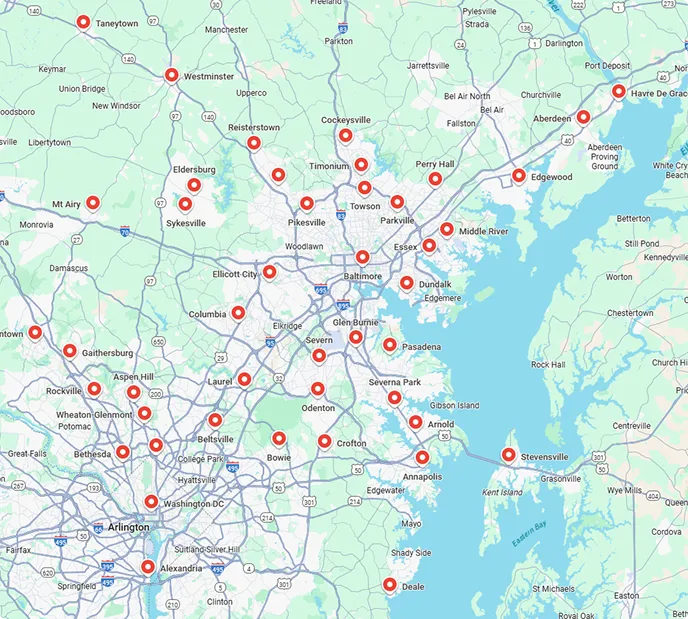
Service areas