

Whole House Dehumidifiers in Towson, MD
In Towson, MD, Tario HVAC provides exceptional whole-house dehumidification, offering continuous moisture control for your entire home. This not only improves indoor air quality but also protects valuable building materials. Our comprehensive approach includes humidity assessment, precise system sizing, expert installation in return plenums or basements, consideration of various drainage options, and thorough routine maintenance. With Tario HVAC, you can expect RH reduction to roughly 40-50%, fewer musty odors, less condensation, and improved comfort without overcooling. Proper integration with your existing HVAC system minimizes short cycling and helps maintain balanced temperature and humidity year-round, creating healthier living spaces. We're here to detail our services, expected results, and offer essential maintenance tips.
.webp)
Whole House Dehumidifiers in Towson, MD
Excess humidity is one of the most common indoor comfort and health issues in Towson homes. Hot, humid summers, humid air from the Chesapeake region, and older houses with less airtight construction make basements, crawl spaces, and upper floors prone to moisture buildup, mold, musty odors, and higher allergy loads. A professionally sized and installed whole house dehumidifier provides continuous moisture control for the entire ducted system or targeted high‑risk areas, improving indoor air quality, protecting building materials, and making your home feel cooler and more comfortable without overworking the air conditioner.
Why whole-house dehumidification matters in Towson, MD
- Towson’s summer humidity and frequent high dew points increase indoor relative humidity (RH) even when air conditioning is running.
- Basements and crawl spaces in older Towson homes often trap moisture from ground and foundation leaks, promoting mold and wood rot.
- Controlling RH to a comfortable range (generally 40 to 50 percent) reduces mold growth, dust mite activity, musty odors, and corrosion on electronics and instruments.
Common whole house dehumidifier issues in Towson homes
- Persistent basement or first-floor dampness despite running an AC unit.
- Intermittent mold or mildew in closets, bathrooms, or around windows after humid spells.
- HVAC short cycling and inefficient cooling because systems struggle to remove moisture.
- Standing condensate or recurring clogs in existing dehumidifier drains.
- Uneven humidity levels between floors or rooms caused by poor airflow or undersized equipment.
Humidity assessment: what to expect
A proper service begins with a humidity assessment to map indoor moisture and determine the load. Typical steps include:
- Measuring RH at multiple locations and heights with calibrated hygrometers during representative conditions.
- Inspecting the basement, crawl space, attic, and HVAC return to identify moisture sources like foundation seepage, poor ventilation, or plumbing leaks.
- Reviewing house size, insulation, duct layout, and typical occupancy or activities that add moisture (laundry, showers, cooking).
- Calculating the moisture load to determine the right capacity and placement. This step avoids common mistakes like oversizing for dehumidification needs or selecting equipment that cannot integrate with your existing HVAC.
System types and placement options
Whole-house dehumidification comes in several configurations. Selection depends on home layout, ductwork, and moisture profile:
- In-duct dehumidifiers: Installed in the return or supply plenum of your central HVAC system to remove moisture from all air moving through ducts. Best for balanced, ducted systems.
- Bypass or dedicated duct models: Use separate duct runs when in-duct installation at the air handler is impractical. Useful for zoned systems or split-type HVAC setups.
- Basement/crawl space units: Engineered for continuous moisture control in below-grade spaces; often mounted on pads and able to pump condensate to a drain.
- Compact whole-home units with built-in pumps: Ideal when gravity drain access is limited. Pumps allow condensate to be routed to a sink, utility drain, or condensate line.
Placement considerations in Towson:
- Mechanical rooms and basements are common installation sites due to space and proximity to returns.
- Avoid placing equipment in unconditioned attics unless properly protected from temperature extremes.
Integration with HVAC systems
Whole-house dehumidifiers can be integrated with your HVAC to balance temperature and moisture removal:
- Direct integration in the return plenum treats all incoming air, improving whole-house RH control.
- Controls and a dedicated humidistat let the dehumidifier run independently of cooling cycles, so moisture is reduced even when the AC is off.
- Proper integration prevents HVAC short cycling and can lower overall cooling load by reducing latent heat, often improving perceived comfort without a lower thermostat setting.
Sizing and performance expectations
Sizing is critical. A unit too small will struggle; an oversized compressor can short-cycle and waste energy. Professional sizing considers:
- Square footage, ceiling heights, insulation levels, and local climate humidity.
- Specific problem areas like damp basements, frequent occupancy, or high indoor moisture activities.Performance expectations:
- A correctly sized system should lower indoor RH to the target 40 to 50 percent range within days of installation under normal Towson summer conditions.
- Expect noticeable reductions in musty odors, condensation on windows, and basement dampness. Long-term benefits include reduced mold and improved comfort without having to overcool your home.
Installation steps (typical process)
- Finalize sizing and equipment selection after assessment.
- Prepare installation location: level pad, electrical connection, and drainage route or pump placement.
- Install unit in return plenum, mechanical room, or basement, with appropriate duct transitions and vibration isolation.
- Connect condensate drain (gravity or pumped) and test for proper flow.
- Integrate control wiring to thermostat or standalone humidistat and program desired RH setpoints.
- Commission system: measure airflow, verify dehumidification rates, and walk-through with homeowner on operation and maintenance.
Drain and condensate options
Towson installations commonly use one of these drain solutions depending on home layout:
- Gravity drain to floor or utility sink when a low point is available.
- Condensate pump for routing to a higher drain or outside when gravity is not possible.
- Tie-in to HVAC condensate drain with backflow prevention if codes allow.Regular checks and proper winterization are important to prevent freeze-up or clogs during colder months.
Routine maintenance and energy considerations
Routine maintenance keeps performance high and operating costs reasonable:
- Replace or clean the dehumidifier air filter per manufacturer guidance, typically every 3 months.
- Clean coils and drain pans annually and inspect condensate lines for blockages.
- Test the humidistat and check for error codes or refrigerant issues during yearly tune-ups.Energy considerations:
- Modern whole-house units are engineered for efficiency; look for units with higher energy factors and smart controls.
- Running a dehumidifier can reduce AC runtime by lowering latent load, often offsetting some energy use.
- Proper insulation, basement waterproofing, and source control of moisture further reduce operating costs.
Typical results for healthier indoor environments
After professional installation and commissioning in Towson homes, homeowners typically see:
- Consistent RH in the 40 to 50 percent range, reducing mold risk and dust mite activity.
- Fewer condensation problems on windows and cold surfaces.
- Reduced musty odors and improved perceived comfort without lowering thermostat settings.
- Better durability for wood floors, cabinetry, and musical instruments sensitive to moisture swings.
- Lower airborne allergen levels and an overall healthier indoor environment for occupants.
Whole-house dehumidification is a practical, long-term solution for Towson homes dealing with seasonal and persistent moisture problems. When matched to your home’s specific needs and integrated with existing HVAC systems, it provides reliable humidity control, improved indoor air quality, and protection for the structure and belongings.

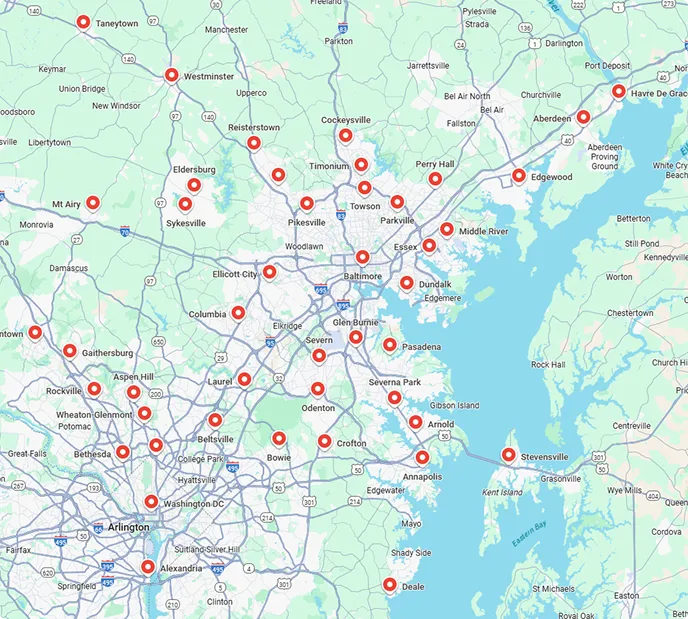
Service areas