

Whole House Air Purifiers in Odenton, MD
Curious how whole-house air purifiers in Odenton, MD can safeguard your indoor air quality? It's all about integrating advanced filtration, adsorption, and germicidal technologies with your existing HVAC system. We'll outline common technologies such as true HEPA, high-MERV filters, activated carbon, UV-C, and electrostatic options, along with diagnostic steps and practical installation approaches for duct, coil, or bypass configurations. Tario HVAC also covers essential maintenance schedules, performance testing, and helps you choose the perfect system based on your home's size, occupancy, specific odor concerns, and humidity levels, all leading to significant long-term benefits.
.jpeg)
Whole House Air Purifiers in Odenton, MD
Whole-house air purifiers in Odenton, MD protect indoor air quality across every room by combining high-efficiency filtration, targeted odor and gas removal, and germ-control technologies with your existing HVAC system. With spring pollen, humid summers that encourage mold growth, and commuter and highway emissions drifting in from nearby corridors, Odenton homes face a mix of allergens, particulate pollution, and moisture-driven contaminants. A correctly specified whole-house system reduces airborne allergens, removes odors and volatile organic compounds (VOCs), and lowers indoor particle counts—helping households with allergies, asthma, pets, or chemical sensitivities breathe easier year-round.
Common whole-house air purifier types and what they solve
Understanding the different technologies helps you match solutions to your home’s needs:
- True HEPA filtration (or whole-house HEPA-grade systems)
- Captures 99.97% of particles down to 0.3 microns (pollen, pet dander, many mold spores, fine dust).
- Best for allergy and particulate reduction. Note: true HEPA in a forced-air system usually requires a dedicated cabinet or bypass configuration because of increased airflow resistance.
- High-MERV pleated filters (MERV 8–13+)
- Easier to integrate into standard HVAC return ducts; MERV 13 is often recommended when HEPA is not feasible.
- Reduces fine particles while balancing airflow and system efficiency.
- Activated carbon / adsorptive media
- Removes odors, volatile organic compounds (VOCs), and smoke by adsorption.
- Important for homes near busy roads, with indoor smoking, or for households sensitive to chemical smells.
- Ultraviolet (UV-C) germicidal lamps
- Mounted near the coil or in the ductwork to inactivate bacteria, mold spores, and some viruses on surfaces and moving air.
- Works best paired with filtration; UV reduces biological growth on cooling coils and surfaces, improving system hygiene.
- Electronic options (electrostatic precipitators, ionizers)
- Can be effective at particle removal but vary widely in performance and may produce ozone if not designed to low-ozone standards. Choose certified low-ozone units if considering these technologies.
Diagnosing indoor-air problems in Odenton homes
A professional assessment helps select and size the right system. Typical diagnostic steps include:
- Review of occupant concerns (allergies, odors, chronic coughing) and home layout (open plan, multi-level).
- Measurement of indoor particulate levels (PM2.5), humidity, and ventilation rates.
- HVAC inspection for airflow, static pressure, and coil cleanliness—important because high-efficiency filtration increases pressure drop.
- Identification of moisture and mold-prone areas (basements, crawlspaces, attic penetrations) given Maryland’s humid summers.
Integration with HVAC systems: practical options
Whole-house purifiers are installed to work with your forced-air system while maintaining airflow and efficiency:
- Duct-mounted in-line filtration: A media filter cabinet installed in the return plenum to house HEPA or high-MERV filters. Best for centralized control and consistent whole-home coverage.
- Bypass or dedicated HEPA systems: A separate air handling path pulls return air through a true HEPA module and returns it to the system to avoid excessive pressure on the furnace or air handler.
- Coil-mounted UV: UV lamps near the AC coil keep the evaporator clean and reduce microbial growth without changing filter sizes.
- Combination media (carbon + particulate): Multi-stage cabinets that contain a prefilter, carbon layer, and fine particulate filter provide balanced removal of particles and gases.
Installation process and what to expect
A professional installation typically follows these steps:
- Pre-installation assessment (home size, HVAC capacity, static pressure testing).
- Selection of system and filter/media configuration tailored to allergy, odor, or smoke concerns.
- Mechanical installation into the return plenum, bypass cabinet, or duct run; UV lamps positioned near coils or in ducts.
- Commissioning: airflow and static pressure checks, leak sealing, and verification of fan performance.
- Baseline performance testing (particle counts or PM2.5) so you can compare before-and-after results.
Maintenance and replacement schedules
Proper maintenance preserves performance and avoids strain on your HVAC system:
- Prefilters: Inspect monthly; replace or clean every 1–3 months depending on dust load and pets.
- Pleated/high-MERV filters: Replace every 3–6 months, or more frequently in high pollen/particulate seasons.
- Whole-house HEPA modules: Typical service intervals are 6–12 months based on manufacturer guidance and measured pressure drop.
- Activated carbon cartridges: Replace every 3–12 months depending on odor/VOC load. Heavy odor sources shorten life.
- UV-C lamps: Replace annually; output declines over time even if the lamp still lights.
- System checks: Annual professional inspection recommended—clean coils, verify airflow, and retest indoor particulate levels.
Performance testing and measurable results
A professional provider can verify purifier performance using objective metrics:
- Baseline and post-installation PM2.5 and particle count measurements. Reduced PM2.5 and particle counts are the most direct indicators of filtration success.
- Allergy symptom tracking: many homeowners report fewer allergy flare-ups and less need for continuous dusting once particle counts decline.
- HVAC metrics: static pressure and airflow testing confirm the system is not overburdened by filtration.
- VOC/odor reduction tests when activated carbon is included for chemical concerns.
Choosing the right system for your Odenton home
Select based on home size, existing HVAC capacity, and specific concerns:
- Homes with chronic allergies or multiple pets: prioritize true HEPA or MERV 13+ filtration, with attention to airflow impacts.
- Residences near highways or with odors: include activated carbon media sized for your home’s air exchange rate.
- High humidity or mildew history: add coil-mounted UV and ensure proper ventilation and dehumidification to reduce mold growth.
- Older HVAC systems: consider a bypass HEPA cabinet or stand-alone whole-house modules to avoid excessive blower strain.
When sizing, professionals will consider square footage, total air volume, and desired air changes per hour (ACH) to ensure media volume and fan capacity match the home’s needs.
Long-term benefits and upkeep
A whole-house purifier properly designed for Odenton conditions delivers year-round benefits: lower airborne allergens in spring and fall pollen seasons, reduced mold spore circulation in humid months, fewer odors, and improved overall indoor comfort. Regular maintenance preserves performance, minimizes energy impact, and extends the life of your HVAC equipment.
By focusing on the right mix of filtration, adsorption, and germicidal control—matched to your home size and local air quality factors in Odenton—you gain measurable reductions in particles and contaminants and a healthier indoor environment for your household.

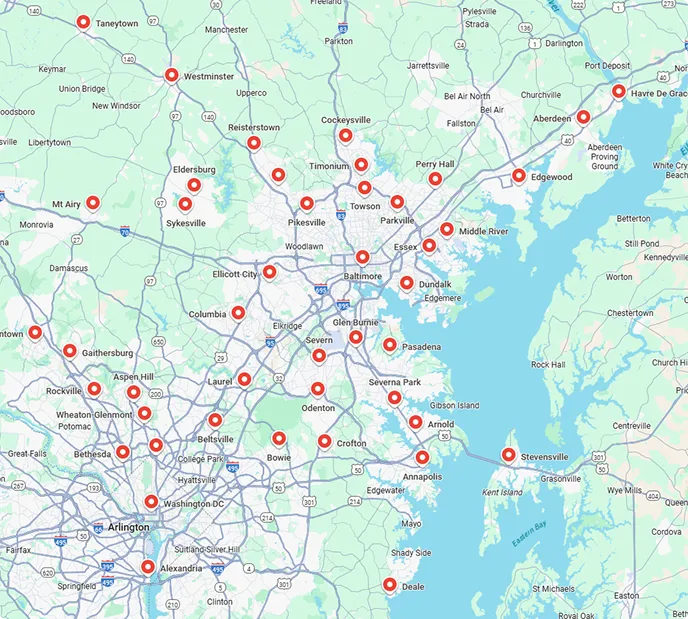
Service areas