

Whole House Air Filters in Odenton, MD
For Odenton, MD homes, whole-house air filters are key. We'll detail how properly selected and maintained filters dramatically improve indoor air quality, reduce allergens, and protect your HVAC equipment. Tario HVAC explains various filter types, MERV ratings, and when to opt for pleated, media, or advanced in-duct HEPA solutions. We'll cover important installation considerations, essential maintenance schedules, and the significant impact on your system's performance. Plus, you'll get practical tips for selecting the right filter and maintaining optimal energy efficiency in your Odenton household. Remember, professional guidance from Tario HVAC ensures proper sizing and a perfect seal for maximum effectiveness.
.jpeg)
Whole House Air Filters in Odenton, MD
A whole house air filter installed in your central HVAC system is one of the most effective ways to improve indoor air quality, reduce allergens, and protect HVAC equipment in Odenton, MD homes. Whether you live in a newer subdivision or an older Annapolis-area property, choosing the right whole house filter and maintaining it on a proper schedule will lower dust, pollen, pet dander, and mold spores while helping your system run more efficiently.
Why whole house filtration matters in Odenton, MD
Odenton sits in the humid mid Atlantic region with distinct pollen seasons, hot humid summers, and cold winters. That climate drives two common indoor air challenges:
- Spring and early summer tree and grass pollen that aggravate allergies.
- High summer humidity encouraging mold and dust mite activity in poorly ventilated spaces.
A whole house filter protects every room served by your forced air system, reducing airborne particles that create allergy symptoms and deposit on HVAC coils, which can lower efficiency and increase energy use.
Common whole house air filter problems Odenton homeowners face
- Frequent spring and fall pollen events causing rapid filter loading.
- Homes with pets where dander and hair clog filters faster.
- Older homes with higher dust infiltration due to gaps in the building envelope.
- Houses with high indoor humidity or past mold issues needing filtration plus dehumidification.
Understanding these patterns helps select the correct filter type and maintenance plan for your household.
Filter types and MERV ratings explained
Filters differ by construction and efficiency. The MERV rating indicates particle capture performance on a scale commonly used in residential and commercial systems.
- Fiberglass panel filters: Low cost, MERV 1 to 4. Good for basic protection of equipment but minimal allergy control. Replace monthly.
- Pleated filters: Common residential option, MERV 6 to 12. Balances filtration and airflow. Replace every 1 to 3 months depending on loading.
- Electrostatic filters: Reusable or disposable; use static attraction to capture particles. MERV ratings vary. Reusable versions need regular cleaning.
- Media (deep-pleat) filters: Thicker 4 to 5 inch cartridges with larger surface area. Higher MERV (8 to 13) with longer life, typically 6 to 12 months.
- In-duct HEPA / True HEPA cabinets: Capture 99.97 percent of particles 0.3 microns and smaller. Require a purpose-built housing and often fan upgrades because HEPA imposes high pressure drop. Equivalent to very high MERV performance but not directly comparable on the MERV scale.
General MERV guidance for Odenton homes:
- General dust control and equipment protection: MERV 6 to 8
- Improved allergy and pet dander control: MERV 8 to 11
- Significant allergy, asthma, or wildfire/very fine particle concerns: MERV 11 to 13 or consider a true HEPA installationNote: Higher MERV means finer filtration but also greater airflow resistance. Your HVAC system must accommodate the increased pressure drop.
Choosing the right filter for your home
Choose by matching indoor air needs, HVAC capability, and maintenance willingness:
- Small households with minimal allergies: Pleated MERV 6 to 8, replaced every 2 to 3 months.
- Households with pets or seasonal allergy sufferers: Pleated or media MERV 8 to 11, replace 1 to 3 months for pleated or 6 to 12 months for media.
- Asthma, severe allergies, or homes near high outdoor pollution: Consider MERV 13 or a properly engineered in-duct HEPA solution. Have a professional evaluate blower capacity and ductwork sealing before installing high-efficiency filters.
- Older homes with high dust infiltration: Media filters provide long life and better dust-holding capacity; also address infiltration with weatherization work.
Installation in central HVAC systems
Whole house filters are installed at the return air opening or inside a dedicated filter cabinet. Key points for a correct installation:
- Observe the airflow direction arrow on the filter. Install with the arrow pointing toward the furnace/air handler.
- Ensure a tight seal around the filter frame to avoid bypass where unfiltered air reenters the system.
- Check filter thickness and rack size; many systems accept 1 inch filters but can be upgraded to a 4 inch media cabinet for better performance and less frequent changes.
- For high-MERV or HEPA components, professional assessment is recommended to confirm the blower can overcome added pressure and to avoid compromising system performance.
Improper installation or use of overly restrictive filters can reduce airflow, decrease comfort, and stress the blower motor.
Maintenance schedules and replacement plans
A consistent maintenance schedule is critical to preserve air quality and system health:
- Pleated disposable filters (1 inch): Check monthly; replace every 1 to 3 months depending on dust and pollen load.
- Media filters (4 inch or greater): Typically last 6 to 12 months; inspect every 3 months during high pollen seasons.
- Washable/reusable filters: Clean monthly and allow to fully dry before reinstalling. Replace periodically since cleaning reduces effectiveness over time.
- High-efficiency filters: Monitor static pressure if possible. If you notice reduced airflow, short cycling, or decreased comfort, inspect and change the filter immediately.
Tip for Odenton residents: Increase inspection frequency during spring pollen and fall leaf drop. Homes with pets should stick to a monthly check.
Impact on system performance and energy use
Installing higher-efficiency filters can slightly increase fan energy use because of added resistance. However, benefits often offset that small increase:
- Cleaner evaporator coils improve heat exchange and can reduce run times, which helps energy consumption.
- Better filtration reduces dust accumulation in ductwork and on components, lowering maintenance and prolonging equipment life.
- The key is balance: choose the highest-rated filter your system can handle without compromising airflow. If you need superior filtration but your system cannot accommodate it, consider a dedicated in-duct HEPA cabinet with its own fan or an air purifier designed for whole-house installation.
- Measure current filter size and plenum depth before purchasing. Upgrading to a thicker media cabinet can allow higher efficiency with less pressure drop.
- Seal return registers and ducts where possible. Filtration works best when your home’s envelope is tight and ventilation is controlled.
- Coordinate filtration upgrades with routine HVAC service. A professional can evaluate your blower, check static pressure, verify proper installation, and recommend the best MERV level for your needs in Odenton.
- Combine filtration with proper humidity control in humid months to reduce mold and dust mite growth.
Whole house filtration tailored to your home and lifestyle delivers measurable relief from pollen and pet allergens, protects HVAC equipment, and creates a healthier indoor environment for Odenton households. Regular inspection and the right filter selection ensure you get these benefits without sacrificing comfort or system performance.

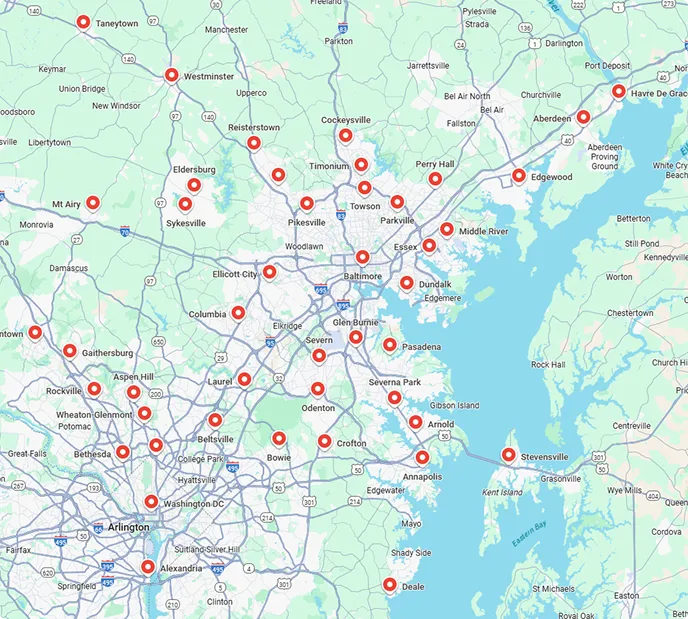
Service areas