

Whole House Air Purifiers in Laurel, MD
Whole-house air purification from Tario HVAC for Laurel, MD homes delivers centralized protection by seamlessly integrating filtration and treatment with your existing HVAC system. Tario HVAC outlines advanced technologies such as HEPA filtration, in-duct UV, electronic cleaners, and activated carbon, explaining how various combinations significantly broaden particulate, microbial, and odor control. We cover expert selection and sizing of systems, optimal installation locations, and essential maintenance needs, plus the expected outstanding performance and health benefits you'll enjoy, including reduced pollen, mold, smoke, and dust, and noticeably improved comfort across all your rooms. At Tario HVAC, our overview helps homeowners plan a reliable, long-term upgrade for superior indoor air.
.jpeg)
Whole House Air Purifiers in Laurel, MD
Clean indoor air is a first-line defense for comfort and health in Laurel, MD homes. Whole house air purifiers work with your HVAC system to reduce allergens, smoke, volatile organic compounds (VOCs), mold spores, pet dander, and many airborne pathogens throughout the entire living space. For Laurel residents facing seasonal pollen, humid summers that encourage mold, and occasional traffic or wood smoke, whole house systems deliver continuous, whole-home protection that portable units cannot match.
Why whole house air purification matters in Laurel, MD
Laurel’s climate and location create a distinct mix of indoor air challenges:
- Spring and early summer bring high pollen counts from trees and grasses common to the area.
- Hot, humid summers increase the risk of mold growth in basements and crawl spaces.
- Proximity to major roadways and metropolitan areas contributes to particulate matter and vehicle-related VOCs.
- Older homes may have higher dust loads and indoor VOC sources like paints, cleaning products, and building materials.
A properly selected whole house air purifier reduces airborne triggers across every room, so bedrooms, living areas, and basements all benefit without the need to move portable units.
Common whole house air purifier types and what they address
Understanding available technologies helps match a system to your home’s needs.
- HEPA filtration
- Removes particles down to 0.3 micron with high efficiency (true HEPA typically rated at 99.97% at 0.3 micron).
- Best for pollen, pet dander, dust, and many smoke particles.
- Requires proper system sizing and attention to filter fit to avoid by-pass.
- UV germicidal lights
- In-duct UV lamps inactivate bacteria, viruses, and mold spores passing through the HVAC coil or air handler.
- Most effective as part of a combined approach, particularly when paired with filtration to remove particles that shade microbes.
- Electronic air cleaners (electrostatic or ionizing)
- Charge particles so they collect on plates or surfaces; effective for fine particulates.
- Can reduce particle concentrations with reusable cells that require periodic cleaning.
- Some designs may produce small amounts of ozone; selection of certified low-ozone units is important.
- Activated carbon (adsorption)
- Targets gases and odors: VOCs, cooking and smoke odors, and chemical smells.
- Works best when sized for the home’s airflow and VOC load; carbon media must be replaced periodically.
Many systems combine these technologies—HEPA + activated carbon for particulates and gases, or HEPA + UV for microbes—to deliver broad-spectrum performance.
Selecting and sizing a whole house purifier for your home
Correct selection balances airflow, filtration efficiency, and HVAC compatibility.
- Match the system to your home’s heating and cooling airflow (measured in cubic feet per minute, CFM). The purifier should be rated for your HVAC’s nominal airflow.
- Consider whole-home air changes per hour (ACH). For allergy and asthma relief, aiming for multiple air changes per hour is typical; higher ACH delivers faster contaminant reduction.
- Evaluate pressure drop and static pressure. High-efficiency filters add resistance; ensure your furnace or air handler can maintain proper airflow without undue strain.
- Use MERV ratings appropriately. High-MERV or HEPA-level filtration removes more particles but can increase static pressure. Some systems use a separate in-duct HEPA cabinet to avoid overloading the main filter rack.
- Account for pollutant types. Homes with strong VOC sources or frequent smoke events should include activated carbon. Homes with recurring respiratory infections or mold issues benefit from integrated UV treatment.
A professional assessment of your HVAC system and living patterns gives the most reliable sizing and configuration.
Installation within the HVAC system
Whole house purifiers are typically installed in the air handler or ductwork for centralized coverage.
- Common locations: on the return plenum, in a dedicated HEPA cabinet downstream of the air handler, or near the coil for UV lamps.
- Electrical needs: UV lights and electronic cleaners require power; installation often includes a dedicated circuit or wiring into the air handler’s electrical panel.
- Integration: systems are sized to the existing ductwork and should not obstruct airflow. Proper sealing and mounting prevent bypass and maintain efficiency.
- Safety and code: installations should follow manufacturer guidance and local electrical and building codes to ensure safe operation.
Maintenance and component care
Ongoing maintenance preserves performance and prevents unintended side effects like increased energy use.
- HEPA and pre-filters: pre-filters trap large particles and extend HEPA life. Replace pre-filters typically every 3-12 months depending on dust load; HEPA media may last 1-3 years depending on use and airflow.
- Activated carbon: replace based on odor breakthrough or manufacturer recommendations, often 6-12 months in homes with moderate VOCs.
- UV lamps: effective life is typically around 9,000 to 12,000 hours (roughly 9-12 months continuous use). Replace annually to maintain germicidal output.
- Electronic cleaner cells: clean reusable plates every 3-6 months to maintain charge efficiency; inspect for corrosion.
- System checks: monitor pressure drop across filters, track HVAC runtime, and consider periodic particle or VOC testing to confirm performance.
Performance metrics and what to expect
Clear performance goals help set realistic expectations.
- Particle reduction: true HEPA filters remove the majority of particles 0.3 micron and larger; combined systems significantly lower particulate counts in a matter of hours depending on ACH.
- VOC and odor reduction: activated carbon adsorption reduces many organic gases and smells, but replacement frequency determines sustained performance.
- Microbial control: UV lamps reduce viable microbes passing the light source, particularly when combined with filtration and moisture control at the coil.
- Measurable outcomes: homeowners commonly track improvements through reduced dust accumulation, fewer allergy symptoms, lower indoor particle counts from a particle counter, and decreased odor complaints.
Health benefits and indoor comfort
While individual health outcomes vary, whole house purification delivers several practical benefits for Laurel homes:
- Reduces exposure to pollen and dust that trigger allergies and asthma symptoms.
- Lowers indoor smoke and fine particle levels during regional smoke events or local cooking/wood-burning.
- Helps control mold spore circulation when paired with proper humidity management.
- Improves perceived indoor air quality across all rooms without moving standalone purifiers.
Whole house systems work best when combined with good ventilation practices, regular HVAC maintenance, and humidity control. For Laurel households dealing with seasonal pollen, humidity-related mold, and urban particulates, an integrated whole house solution offers consistent, homewide protection and measurable air quality improvements.

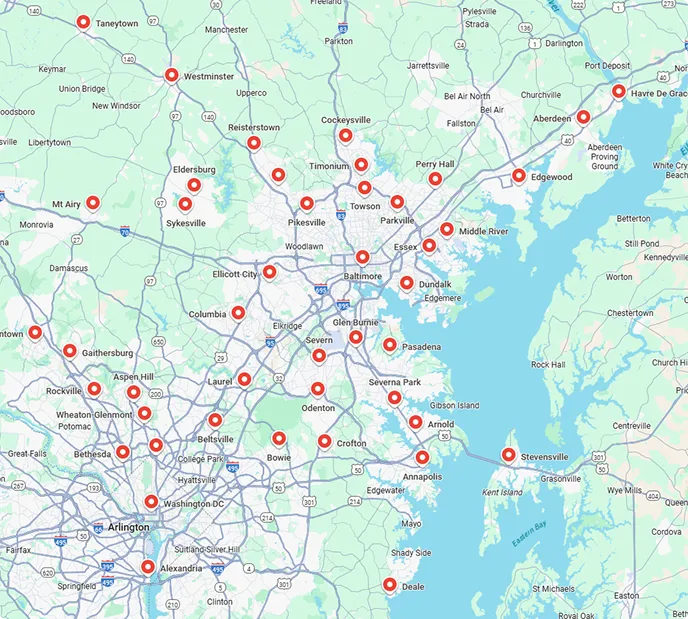
Service areas