

Whole House Air Filters in Cockeysville, MD
For Cockeysville, MD homes, Tario HVAC offers comprehensive whole-house air filtration guidance. We cover selecting the right filters, understanding MERV ratings, various installation options, appropriate replacement intervals, and how to balance filtration with HVAC efficiency. Our team outlines common local air quality factors, compares pleated, deep-pleat, and HEPA cabinet options, and explains how the installation method and filter choice affect airflow. This guide from Tario HVAC helps homeowners match the filtration level to their specific needs, whether it's for allergies, pets, or occupancy, while also offering essential maintenance tips to preserve comfort, energy efficiency, and indoor air quality year-round.
.jpeg)
Whole House Air Filters in Cockeysville, MD
Whole house air filtration is one of the most effective ways to improve indoor air quality for Cockeysville, MD homes. With suburban tree cover, seasonal pollen, vehicle traffic along nearby corridors, and hot humid summers that encourage dust mite and mold growth, selecting the right whole house filter helps reduce allergens, dust, pet dander, and fine particles that aggravate asthma and allergies. This page explains how MERV ratings work, how to choose between filter types, installation options, replacement intervals, and how to balance filtration with HVAC efficiency in Cockeysville homes.
Common whole house air quality issues in Cockeysville, MD
- Seasonal pollen spikes in spring and early summer that increase allergy symptoms.
- Elevated dust and leaf debris in fall from wooded neighborhoods.
- Increased indoor humidity in summer that can lead to mold spores and dust mite activity.
- Fine particulate matter (PM2.5) from regional vehicle traffic and occasional outdoor smoke or haze.
- Everyday household particles: pet dander, cooking aerosols, and general dust.
Understanding these local factors helps determine the right filtration level and maintenance schedule.
How MERV ratings work and what they mean for your home
MERV stands for Minimum Efficiency Reporting Value. It is a scale from 1 to 16 that describes how effectively a filter captures particles of different sizes.
- MERV 6 to 8: Good for large particles like pollen, dust, and lint. Common in basic fiberglass or low-cost pleated filters.
- MERV 8 to 11: Effective for smaller allergens such as mold spores, pet dander, and finer dust. A good balance for many homes.
- MERV 12 to 13: High-efficiency for removing fine particles including many PM2.5 particles and some bacteria-sized aerosols. Recommended for households with allergies or respiratory issues.
- MERV 14 to 16 and HEPA: Captures the smallest particles at very high rates. True HEPA performance usually requires a dedicated HEPA cabinet because standard residential HVAC systems are not designed for the increased resistance without modification.
For most Cockeysville homes, MERV 8 to 13 is the practical range. MERV 13 is often the target if allergy control and fine particle removal are priorities, provided the HVAC system can tolerate the added pressure drop.
Whole house filter types and selection
- Standard pleated filters: Common, inexpensive, and available up to MERV 13. Good for routine dust and pollen control.
- Deep-pleat media filters: Thicker, larger surface area filters that provide higher efficiency with lower pressure drop compared to same-rated thin pleats. Ideal when you want high filtration without hurting airflow.
- In-duct HEPA cabinets: Separate housings with HEPA media installed in-line with the ductwork. They achieve very high filtration but require specific cabinet sizing and blower capacity.
- Electronic air cleaners and ionizers: Can remove very small particles but effectiveness varies. Some produce ozone, so consider tradeoffs and local health guidelines.
- Hybrid systems: Combine media filtration with UV lamps for microbial control in high-humidity homes prone to mold.
Choose a filter type based on allergy needs, presence of pets or smokers, and HVAC system compatibility.
Installation methods: what Cockeysville homeowners should expect
- In-duct filter at the air handler: The most common approach. Filters sit in a cabinet at the furnace or air handler where they filter return air before it reaches the system. Proper cabinet sizing and a tight seal are important.
- Return grille filters: Simpler installations place filters in the return grille. They are easy to access but often limited to thinner filters and lower MERV ratings.
- Media filter housings: Larger in-duct housings that accept deep-pleat media filters and offer higher efficiency with less pressure drop.
- Dedicated HEPA cabinet: Installed inline with ductwork and sized to maintain airflow while achieving HEPA performance.
Proper installation includes ensuring the filter fits well, seals are tight to prevent bypass, and the housing can handle the selected filter thickness and rating.
Recommended replacement intervals
Replacement frequency depends on filter type, MERV rating, and household conditions:
- Thin pleated filters (MERV 8 to 11): Replace every 1 to 3 months. Check monthly during pollen season.
- Deep-pleat media filters: Replace every 6 to 12 months depending on loading. Inspect twice a year.
- High-use or high-pollutant homes (pets, smokers, heavy pollen): Expect to replace pleated filters more often, sometimes monthly.
- In-duct HEPA or media cabinets: Follow manufacturer guidance, often 9 to 12 months, with more frequent checks during high pollen or smoke events.
Visual inspection and checking pressure drop are the best ways to decide when replacement is needed.
Impact on system performance and airflow
Higher-efficiency filters capture more particles but usually increase resistance to airflow (pressure drop). Consequences include:
- Reduced airflow to living spaces, which can reduce comfort and system efficiency.
- Increased runtime and energy use if the blower works harder to maintain airflow.
- Potential strain on older furnaces or air handlers with fixed-speed motors, which can shorten equipment life.
Mitigation strategies include choosing deep-pleat media filters that achieve high MERV with lower pressure drop, ensuring ducts are well sealed, and confirming your HVAC blower can accommodate the filter. Variable speed blowers handle higher-resistance filters better than single-speed units.
Tips for balancing filtration with HVAC efficiency in Cockeysville homes
- Choose the highest MERV rating compatible with your HVAC system. Consult system documentation or an HVAC professional to confirm allowable pressure drop.
- Prefer deep-pleat media filters when you need MERV 11 to 13 performance with less impact on airflow.
- Inspect filters monthly during high pollen seasons and replace as soon as they show visible loading.
- Improve overall system efficiency with regular HVAC maintenance, clean coils, and sealed ducts to reduce the load on filters and blower.
- Consider adding a dedicated in-duct HEPA cabinet if you need near-HEPA performance without altering the main air handler.
- Use whole-house ventilation or humidity control in summer to reduce mold and dust mite conditions, which helps filters perform better over time.
- Monitor indoor comfort and energy consumption after upgrading filtration; if airflow drops noticeably, evaluate switching to a lower pressure-drop media or upgrading the blower.
Whole house air filters in Cockeysville, MD are a practical investment for households dealing with pollen, seasonal dust, humidity-driven contaminants, and fine particles from traffic. Selecting the right MERV rating and filter type, installing properly, and following recommended replacement intervals will maximize indoor air quality benefits while minimizing negative effects on HVAC performance. With the right balance, homeowners can significantly reduce allergens and particulates, improving comfort and health year round.

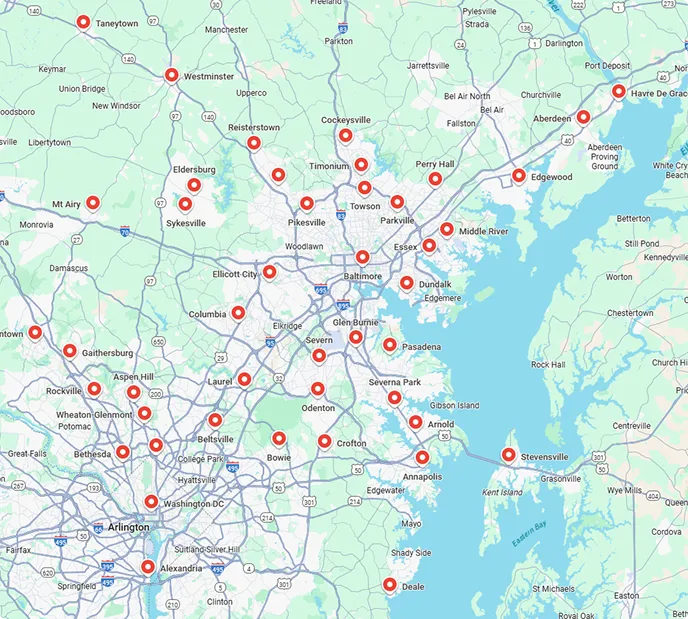
Service areas