

Whole House Air Purifiers in Silver Spring, MD
For Silver Spring homes, we at Tario HVAC explain whole-house air purifiers in detail, covering technologies like true HEPA, MERV, electronic precipitators, UV-C, and PCO, along with installation options (in-duct vs. standalone). We'll show how each approach impacts allergens, particulates, and microbes. We cover essential performance metrics, certifications, and maintenance schedules, plus provide expert guidance on sizing, ideal placement, and selecting systems perfect for your humidity and ventilation concerns. You'll learn which purifier best fits your specific goals, whether it's tackling pollen, mold, VOCs, or simply improving general air quality, and how to verify results with professional testing and regular upkeep.
.jpeg)
Whole House Air Purifiers in Silver Spring, MD
Cleaner indoor air is one of the easiest ways to improve comfort and health at home — especially in Silver Spring where seasonal pollen, humid summers, and vehicle exhaust from nearby highways contribute to year-round indoor contaminants. Whole house air purifiers treat air at the system level so every room benefits without relying on multiple portable units. This page explains the technologies available (true HEPA, electronic, UV, PCO), how they reduce allergens, particulates, and microbes, installation options (in-duct vs standalone), measurable performance metrics and certifications, maintenance needs, and how to choose the right system for your Silver Spring home.
Why whole-house air purification matters in Silver Spring, MD
- Spring and fall bring heavy pollen (trees, grasses, ragweed) that penetrate homes and trigger allergies.
- High summer humidity encourages mold growth in basements and crawlspaces, increasing spore counts indoors.
- Wintertime sealed homes and HVAC use concentrate indoor pollutants — cooking particulates, pet dander, and VOCs.
- Proximity to I-495 and urban traffic raises fine particulate (PM2.5) and exhaust-related pollutants in many neighborhoods.
A properly sized whole-house purifier integrated with your HVAC system reduces exposure to these pollutants consistently, lowering room-to-room variability and easing management for allergy or asthma sufferers.
Common whole-house air purification technologies
- True HEPA filtration
- Captures 99.97% of particles down to 0.3 microns (typical HEPA spec). Effective for dust, pollen, pet dander, and many respiratory aerosols.
- Works by forcing return air through a dense filter media; best for particulate removal.
- High-efficiency MERV filters
- MERV 8–13 are common for homes; MERV 13 captures a large portion of PM2.5 and is frequently recommended when HVAC can accommodate the pressure drop.
- Easier to retrofit than full HEPA in some systems.
- Electronic precipitators / electrostatic filters
- Charge and collect particles on metal plates or media. Good for fine particles and long-term cost savings.
- Some units produce ozone; choose CARB-compliant or certified low-ozone models if ozone is a concern.
- Ultraviolet (UV-C) light
- Installed in return ducts or near the coil to inactivate bacteria, mold spores, and some viruses that pass by the lamp.
- UV reduces biological growth on coils and drain pans, improving HVAC performance; it does not remove particulates.
- Photocatalytic Oxidation (PCO)
- Uses UV light and a catalyst to break down VOCs and odors into simpler compounds.
- Can reduce certain gases better than filtration but may produce byproducts; select systems with independent testing and low byproduct emissions.
In-duct vs standalone whole-house solutions
- In-duct (integrated with HVAC)
- Treats the entire home when the air handler runs; hidden and maintenance centralizes at the furnace/air handler.
- Requires assessment of HVAC blower capacity and duct layout — high-efficiency filters or HEPA can add static pressure and may need a compatible fan or bypass design.
- Best for consistent, whole-home coverage in single-family homes and larger multi-room layouts.
- Standalone (dedicated whole-house units)
- Installed in-line with return or as a dedicated air handler; can include fans sized specifically for purification rather than relying on the existing blower.
- Useful for homes with older HVAC systems that cannot tolerate higher static pressure.
- Portable room units
- Useful for renters or targeted treatment (bedroom, nursery), rated with CADR. Not a whole-house solution but can supplement system-level purification.
Performance metrics and certifications to look for
- HEPA efficiency: 99.97% at 0.3 microns (H13/H14 classifications for higher efficiency).
- MERV rating: indicates particle capture across size ranges; aim for MERV 13+ where HVAC airflow can support it.
- CADR (Clean Air Delivery Rate): common for portable units; gives room-level performance.
- ACH (Air Changes per Hour): for whole-house design, expect recommendations based on desired ACH (4–6+ for allergy/asthma considerations).
- Safety and emissions: UL listing for electrical safety, CARB compliance for ozone emissions where applicable, and AHAM verification when available.
- Manufacturer testing: look for third-party lab results for VOC reduction, microbial kill rates, and byproduct monitoring (especially for PCO and ionizing technologies).
Typical installation and performance verification process
- Home assessment: evaluate HVAC type, blower CFM, duct design, existing filter rack size, and occupant needs (allergies, pets, smoking, VOC concerns).
- System selection: choose technology (HEPA, MERV upgrade, electronic, UV, PCO) or a hybrid approach based on contaminants of concern and HVAC capacity.
- Sizing and placement: size the purifier to match HVAC CFM or room volumes and determine optimal duct locations (return plenum, upstream of coil for filtration; downstream coil for UV).
- Installation: mechanical mounting, electrical connections for powered units or lamps, and ensuring proper sealing to avoid bypass leakage.
- Testing: measure static pressure, airflow (CFM), and where applicable, particle counts or VOC readings to verify performance meets design targets.
Maintenance and replacement schedules (typical)
- Pre-filters: inspect every 1–3 months; replace or clean as needed to protect downstream media and maintain airflow.
- True HEPA or high-efficiency media filters: replace every 12–36 months depending on load, indoor sources, and pressure drop monitoring.
- Electronic precipitator collector plates: clean monthly to quarterly based on usage and manufacturer guidance.
- UV-C lamps: replace every 9–24 months depending on lamp type and hours of operation; clean sleeves annually.
- PCO catalysts: replace per manufacturer specs, commonly every 2–5 years, and monitor for decreased VOC reduction performance.
- Annual HVAC check: verify fan capacity and static pressure, confirm seals, and measure before/after particle counts if validation is desired.
Which system is right for your Silver Spring home?
- For pollen and particulate-focused concerns (seasonal allergies, pets, smoke): a whole-house HEPA or MERV 13+ solution sized to your HVAC is typically most effective.
- For mold and microbial control in humid basements or homes: combine a good filtration system with UV-C installed near the coil and address moisture sources.
- For VOCs, odors, and chemical sensitivities (paints, cleaners, new construction): consider activated carbon stages and PCO units that are independently tested for byproducts.
- If your HVAC blower is older or cannot handle higher resistance: choose a dedicated in-line purifier with its own fan or a high-efficiency electronic precipitator rated for low pressure drop.
- For renters or targeted needs: high-CADR portable HEPA units in bedrooms can supplement but will not deliver whole-home coverage.
Benefits for allergy and asthma sufferers
- Reduced airborne allergen loads (pollen, pet dander, dust mite fragments) throughout the home, not just in one room.
- Fewer visible particulates and odors, and a lower baseline of PM2.5 from outdoor pollution and indoor sources.
- Improved HVAC efficiency and reduced mold growth when filtration is paired with UV and moisture control—helpful in Silver Spring’s humid months.
- Predictable maintenance schedules to keep performance steady over time, reducing sudden declines in indoor air quality.
Selecting and installing a whole-house air purifier is a technical decision that balances contaminant type, HVAC capability, and household priorities. For homes in Silver Spring, MD, prioritizing particulate capture (HEPA/MERV) and addressing humidity-driven biological growth will provide the most noticeable improvements in comfort and indoor air quality. Regular maintenance and attention to certifications (HEPA efficiency, CARB/UL compliance, AHAM verification where applicable) ensure the system continues to perform as designed.

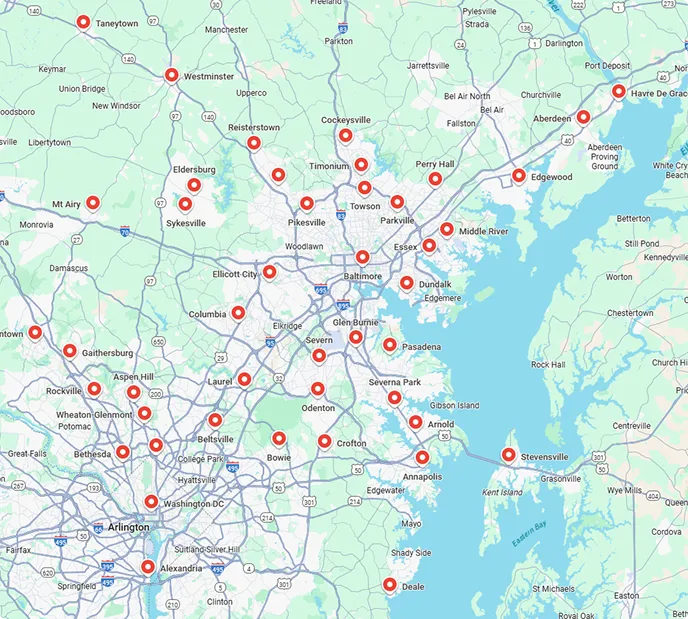
Service areas