

Whole House Air Filters in Owings Mills, MD
Owings Mills residents can significantly improve their indoor air quality with whole-house filtration by selecting the right filters for allergens, dust, and smoke, and by understanding crucial system compatibility. Tario HVAC will explain common filter types, MERV ratings, and important installation considerations, along with vital maintenance schedules, optimal replacement timing, and upgrade options like high-MERV and HEPA solutions. We'll also highlight how filtration impacts airflow and energy use, providing practical tips for choosing the perfect solution, evaluating humidity levels, and effectively reducing mold risk throughout the year.
.jpeg)
Whole House Air Filters in Owings Mills, MD
Keeping your home’s air clean in Owings Mills, MD matters year round. Local pollen seasons, humid summers that promote mold growth, winter indoor heating, and neighborhood traffic all influence indoor air quality. This page explains whole-house air filtration options, how to choose the right filter for specific concerns (allergens, dust, smoke), effects on airflow and system efficiency, installation and maintenance, upgrade choices, cost considerations, and practical FAQs tailored to Owings Mills homes.
Why whole-house filtration matters in Owings Mills
Owings Mills experiences tree and grass pollen in spring and early summer, higher indoor humidity in summer that can increase mold spores, and seasonal wood-burning or regional smoke events that introduce fine particles (PM2.5). A whole-house filter installed in the HVAC return protects the whole home by reducing airborne particles, limiting dust build-up on surfaces, and lowering allergen loads that aggravate asthma and allergy sufferers.
Common whole-house filter types and MERV ratings
Understanding filter types and MERV ratings helps match performance to needs:
- Fiberglass/basic disposable filters (low MERV, typically 1 to 4)
- Good for protecting HVAC equipment from large debris.
- Not effective for allergens, smoke, or fine particles.
- Pleated filters (MERV 6 to 11)
- Balanced airflow and particle capture; common residential choice.
- Effective for pollen, pet dander, and moderate dust.
- High-MERV pleated filters (MERV 12 to 13)
- Capture smaller particles including some mold spores and fine smoke particles.
- Often recommended for homes with allergies or nearby smoke exposure; requires HVAC compatibility check.
- Media filters (deep-pleat, thicker housing)
- Higher dust-holding capacity and longer life; available in higher MERV ratings with less airflow restriction relative to their performance.
- Whole-house HEPA or bypass HEPA systems
- True HEPA captures 99.97 percent of particles 0.3 microns and larger.
- Typically require a dedicated air handler or bypass design to avoid excessive static pressure on the main HVAC.
- Electronic/ionizing purifiers and UV germicidal lamps
- Target fine particles, smoke, and microbes; best used as adjuncts to mechanical filtration when addressing specific contamination or microbial concerns.
How to choose the right filter for your specific concerns
- Allergies and pet dander: Choose MERV 8 to 13 pleated filters or a media filter that balances capture and airflow. Higher MERVs reduce allergen load but confirm compatibility.
- Dust and renovations: A thick media filter or higher MERV pleated filter with frequent replacement helps trap construction dust and reduce cleaning frequency.
- Smoke and PM2.5 (regional or fireplace smoke): Aim for MERV 13 or higher, or a whole-house HEPA solution. If a HEPA retrofit is not feasible, a high-performing media filter can still significantly reduce fine particles.
- Mold and humidity-related spores: Combine a high-capture filter with humidity control and periodic duct inspection; filtration alone will not eliminate moisture issues.
Airflow, system efficiency, and compatibility
Higher MERV filters capture smaller particles but increase static pressure. Increased pressure can:
- Reduce airflow and comfort
- Increase fan run time and energy use
- Shorten HVAC component life if the system is not rated for higher pressure
Before upgrading to a high-MERV or HEPA solution, have the HVAC system evaluated for fan capacity, filter housing size, and static pressure limits. In many cases, switching to a thicker media filter or modifying the system with a dedicated clean-air handler delivers better results without compromising efficiency.
Installation in HVAC systems
Whole-house filters are typically installed at the air handler or in the return plenum. Professional installation ensures:
- Correct filter size and orientation
- Proper sealing to prevent bypass
- Measurement of static pressure before and after installation
- Integration with existing HVAC components if moving to a media, high-MERV, or HEPA bypass system
Proper installation prevents leaks and preserves both filtration performance and equipment efficiency.
Recommended replacement schedules and maintenance plans
Replacement depends on filter type, home occupancy, pets, and local environmental loads:
- Basic disposable filters: inspect monthly; replace as needed, usually every 1 to 3 months.
- Pleated filters (MERV 8 to 11): check every 1 to 3 months; typical replacement every 3 months for average homes.
- High-MERV pleated or media filters: inspect quarterly; many media filters last 6 to 12 months depending on load.
- Whole-house HEPA and electronic systems: follow manufacturer guidance and schedule professional service annually.
A maintenance plan should include seasonal HVAC tune-ups, filter reminders, annual static pressure checks, and humidity control inspections to minimize mold risk.
Upgrade options and practical considerations
- Media filter retrofit: Upgrades filter performance without extreme increases in static pressure. Good balance for many homes.
- High-MERV pleated filters: Improve capture of fine particles; confirm HVAC compatibility.
- Whole-house HEPA: Best for occupants with severe allergies, immune-compromised residents, or persistent smoke exposure; often needs a dedicated solution to avoid airflow penalties.
- Add-on technologies: UV lights for microbial control, electronic air cleaners for smoke and fine particles—use as supplements rather than primary filtration methods.
Cost considerations
Factor in:
- Initial equipment or retrofit cost
- Ongoing filter replacement frequency and material cost
- Potential changes in energy use if filter pressure increases
- Long-term savings from fewer HVAC repairs, less dust cleanup, and improved occupant health
Choosing a solution matched to system capacity minimizes unnecessary operational costs.
Benefits for indoor air quality in Owings Mills, MD homes
- Reduced pollen and allergen exposure during peak spring and early summer
- Lowered dust accumulation from local construction and traffic
- Improved protection against regional smoke events and indoor combustion particles
- Reduced mold spore circulation when combined with humidity control
- Protection for HVAC equipment and more consistent system performance
Frequently asked questions
- Can I use a MERV 13 filter in my current HVAC system?
- Possibly, but check static pressure and fan capacity first. Many systems tolerate MERV 11 to 13 with proper filter housing or a thicker media filter.
- Will a whole-house filter eliminate allergy symptoms?
- Filters reduce airborne allergens, which often reduces symptoms, but not entirely. Combine filtration with cleaning, humidity control, and targeted allergen reduction for best results.
- How often should I change a media filter vs a pleated filter?
- Media filters often last longer, commonly 6 to 12 months depending on load. Pleated filters typically need more frequent replacement, around every 3 months for average homes.
- Can a HEPA filter be installed in a standard furnace?
- Standard furnaces usually need modification or a dedicated bypass/air handler to support HEPA without harming airflow. Professional evaluation is required.
- Do high-efficiency filters increase energy bills?
- If the HVAC fan must work harder to overcome increased static pressure, energy use can rise. Properly sized media filters or system upgrades limit this effect.
- How does Maryland humidity affect filtration?
- High humidity does not reduce filter particle capture, but it increases mold growth risk. Pair filtration with humidity control and regular inspections to prevent mold in ducts and filters.
Choosing the right whole-house air filtration solution in Owings Mills balances particle capture, airflow, and system compatibility. Consider local pollen cycles, humidity, and potential smoke events when selecting a filter type and replacement schedule to maintain healthy indoor air year round.

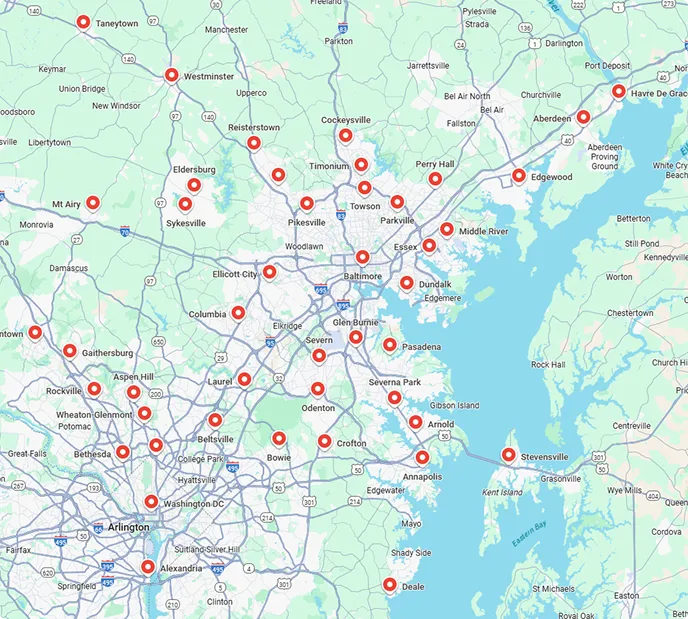
Service areas