

Whole House Air Purifiers in Middle River, MD
Whole-house air purification for Middle River homes is a game-changer, reducing allergens, odors, and pollutants by filtering air through your existing duct system, delivering consistent, high-quality air to every room. We'll compare advanced technologies like HEPA, electronic cleaners, UV-C, and activated carbon, explaining ideal installation locations, maintenance needs, and proper sizing. We also offer practical recommendations for allergy and asthma relief. Tario HVAC emphasizes the importance of multi-stage filtration, achieving proper ACH targets, effective moisture control, and regular inspections to truly maximize performance and comfort. By ensuring correct sizing and seamless integration with your HVAC controls, homeowners can achieve measurable improvements in their air quality.
Whole House Air Purifiers in Middle River, MD
Keeping indoor air clean in Middle River, MD matters year round. Local humidity, seasonal pollen from trees and grasses, vehicle and industrial emissions in the Baltimore metro area, and occasional smoke events all increase indoor pollutant load. A properly specified whole house air purifier installed with your ducted HVAC system reduces allergens, odors, and many airborne pathogens throughout your home while protecting HVAC equipment and improving comfort for people with allergies or asthma.
Why choose a whole house system for Middle River homes
- Whole home coverage treats every room through the existing duct system rather than relying on single-room units. This is critical for allergy and asthma management because contaminants travel and recontaminate untreated rooms.
- Maryland humidity and seasonal mold pressure mean whole-house filtration helps reduce spores circulating from basements, attics, and damp areas.
- Homes near busy roads or industrial corridors benefit from integrated activated carbon and high-efficiency particle filtration to reduce vehicle exhaust, VOCs, and fine particulate matter (PM2.5).
Common whole house air purifier issues in Middle River, MD
- Reduced airflow when filters are clogged or when a high-efficiency filter increases static pressure beyond the furnace blower capacity.
- Persistent odors when activated carbon media is saturated.
- Ozone generation and eye/throat irritation with some electronic precipitators if not properly specified.
- UV lamp degradation causing lower pathogen inactivation after 9 to 12 months.
- Incompatibility with variable-speed or ECM blowers if the system adds significant resistance.
Technologies compared: HEPA, electronic, UV, activated carbon
- HEPA (High Efficiency Particulate Air)
- Captures 99.97% of particles down to 0.3 micron when tested at rated airflow.
- Excellent for pollen, dust mite debris, pet dander, and many mold spores.
- In ducted systems, HEPA often requires a dedicated fan or ensuring furnace blower can handle the added pressure drop.
- Electronic air cleaners (electrostatic precipitators and ionizers)
- Use charged plates to collect particles; can be very efficient for fine particles when properly maintained.
- Require periodic cleaning of collection cells; some older models produce ozone which is undesirable for sensitive occupants.
- UV germicidal irradiation (UV-C)
- Reduces microbial load on coil surfaces and in passing air; effective at damaging bacteria and some viruses with sufficient exposure time and intensity.
- Best used in combination with particle filtration; UV alone does not remove particles or odors.
- Activated carbon
- Adsorbs gases, VOCs, smoke, and odors; effectiveness depends on carbon quantity, surface area, and contact time.
- Essential for households with cooking odors, wildfire or tobacco smoke, and chemical smells.
Performance metrics that matter
- Single-pass efficiency: percent of particles removed in one pass through the system; HEPA approaches 99.97% for rated particles, while combined systems (HEPA + carbon + UV) provide broader protection.
- Clean Air Delivery Rate (CADR) and whole-home equivalents: for whole-house systems use air changes per hour (ACH) and calibrated CFM sizing rather than room CADR alone.
- ACH guideline: aim for 3 to 6 ACH for meaningful reduction of airborne contaminants; higher ACH provides faster reductions during high pollutant events.
- Example sizing calculation: Required CFM = (Home volume in cubic feet x Desired ACH) / 60. For a 2400 sq ft home with 8 ft ceilings (volume 19,200 cu ft) and 4 ACH, you need about 1280 CFM.
- Pressure drop: higher-efficiency filters and media add static pressure; verify furnace/air handler capacity to avoid reduced heating/cooling performance.
Installation locations and compatibility with ducted systems
- Common installations: return-air plenum, return grille, or dedicated bypass housing. Placement should maximize whole-home circulation and minimize bypass leaks.
- For split systems with high-efficiency filters like HEPA, many installers use a dedicated fan or a specially designed in-duct unit to overcome pressure drop.
- Variable-speed furnaces and air handlers may require controls integration to ensure proper run cycles for filtration and UV light operation.
- Older homes with leaky ducts benefit from duct sealing before installation to avoid pulling pollutants from attics or crawlspaces into the conditioned stream.
Maintenance and filter replacement schedules
- Pre-filters: check every 1 to 3 months; replace or clean as needed to protect downstream media and maintain airflow.
- HEPA or high-efficiency media: typical replacement every 12 to 18 months depending on loading and indoor pollutant levels. In high-pollen or smoky seasons, lifecycle shortens.
- Activated carbon modules: replace every 6 to 12 months or when odors return. Performance depends on VOC concentration and carbon volume.
- UV lamps: replace annually for consistent germicidal output; lamp intensity degrades over time even if the bulb still emits visible light.
- Electronic collector cells: clean monthly to quarterly depending on loading.
- Annual professional inspection: verify seals, airflow, static pressure, lamp output, and media condition.
Expected reductions and realistic outcomes
- Allergens (pollen, pet dander, dust mite debris): HEPA filtration typically removes 90% or more of airborne allergens that pass through the system; whole-home systems reduce overall indoor exposure significantly when sized and maintained correctly.
- Fine particles and smoke (PM2.5): combined HEPA and activated carbon systems can reduce PM2.5 and smoke particles by 80% or more in a well-sealed, properly sized home during filtration cycles.
- Odors and VOCs: activated carbon can remove many odors and some VOCs, often achieving 60 to 90% reduction depending on contact time and carbon volume.
- Pathogens: UV-C with adequate exposure and intensity provides log reductions in microbial load on coils and in pass-through air; combining UV with HEPA improves overall removal and reduces viable airborne pathogens more than either alone. Exact reductions vary with airflow, dwell time, and organism type.
Recommendations for households with allergies or asthma in Middle River
- Prioritize a multi-stage approach: a quality pre-filter, HEPA or high-MERV media for particles, plus activated carbon for odors and smoke. Consider UV if you have recurrent mold or are concerned about microbial growth on coils.
- Size the system to the home volume and desired ACH. Undersized systems will not provide the expected symptom relief.
- Address humidity and moisture sources in Middle River homes to reduce mold spore generation; filtration helps but moisture control is critical.
- Monitor filter life and replace media more often during spring pollen peaks and summer humidity or when smoke events occur.
- If you have a variable-speed HVAC blower, confirm compatibility and run-time settings to ensure sufficient air cycling through the purifier.
Whole house air purification is a decision-focused solution for cleaner indoor air throughout a Middle River home. When systems are chosen and integrated with attention to technology mix, sizing, and maintenance, households with allergies, asthma, or sensitivity to odors and smoke see measurable improvements in indoor air quality and symptom reduction.

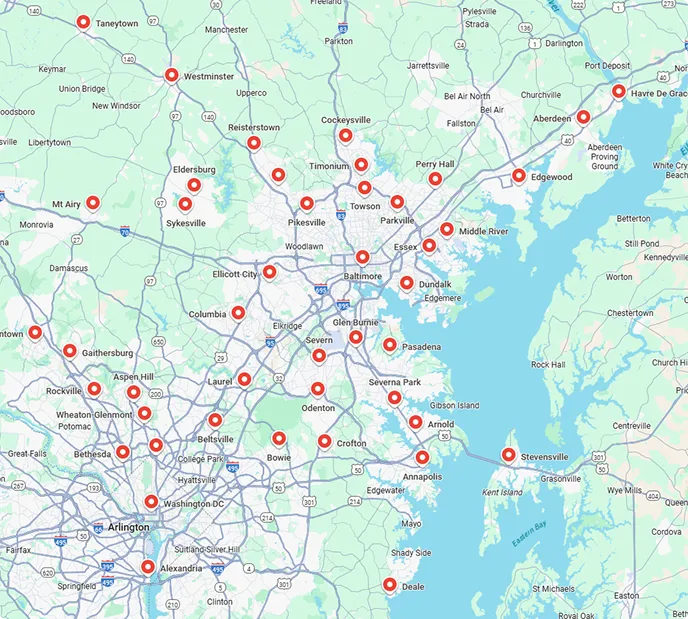
Service areas