

Heat Pump Repair in Owings Mills, MD
Heat pump repair in Owings Mills, MD covers common failure causes, diagnostic approaches, and repair strategies for both heating and cooling performance in local climates. The page outlines typical issues such as no heat, short cycling, ice buildup, weak airflow, and strange noises, and explains how professional technicians diagnose root causes, test refrigerant and electrical systems, and determine whether component repair or part replacement is appropriate. It also addresses parts compatibility, warranty considerations, emergency timelines, technician qualifications, and guidance on choosing repair versus replacement.
.webp)
Heat Pump Repair in Owings Mills, MD
When your heat pump starts underperforming in Owings Mills, MD, you need targeted, reliable repair that considers local climate demands and seasonal usage. Heat pumps provide both heating and cooling here—handling humid summers and cold winters—so small faults left unaddressed can quickly become costly failures.
Why timely heat pump repair matters in Owings Mills
Owings Mills experiences hot, humid summers and chilly winters. That seasonal load stresses compressors, reversing valves, and refrigerant circuits. Delaying repair can reduce efficiency, raise energy bills, and accelerate wear on components already stressed by frequent cycling. Prompt, professional service restores comfort, preserves efficiency, and helps avoid emergency breakdowns during extreme weather.
Common heat pump issues in Owings Mills homes
- No heating or cooling — unit runs but delivers little conditioned air (often refrigerant leaks, compressor failure, or control board faults).
- Short cycling — frequent on/off cycles that stress the system (commonly caused by low charge, faulty thermostats, or defrost control problems).
- Weak airflow — poor blower operation, clogged filters, or duct problems reduce effectiveness.
- Ice buildup on outdoor unit — defective defrost controls, sensors, or low refrigerant cause icing during cold weather.
- Strange noises or vibration — failing bearings, loose mounts, or failing compressors generate clunks, squeals, or rattles.
- High energy bills — reduced efficiency from worn components, dirty coils, or improper refrigerant levels.
- Error codes or frequent tripping — electrical issues, capacitor failure, or control board faults.
Diagnostic and testing procedures you can expect
A professional repair approach follows a consistent diagnostic path to isolate root causes rather than chase symptoms:
- Visual inspection of indoor and outdoor units for obvious damage, signs of leaks, and airflow restrictions.
- System performance testing: measuring refrigerant pressures, superheat/subcooling, compressor amperage, and temperature differential across the coil.
- Electrical diagnostics: checking contactors, relays, capacitors, fuses, and control voltages.
- Defrost and reversing valve checks for correct operation in heating mode.
- Duct and airflow evaluation, including static pressure where needed.
- Manufacturer-specific fault code retrieval and interpretation.
These tests identify whether the issue is repairable on a component level or if deeper system problems suggest replacement.
Common component repairs and replacements
- Compressors — often the most expensive repair; replaced when mechanically failed or electrically shorted. Compatibility with the outdoor unit and refrigerant type matters.
- Capacitors and contactors — common causes of no-start conditions and noisy operation; typically replaced during a standard service visit.
- Reversing valves — crucial for switching between heating and cooling; failure causes stuck mode operation.
- Thermostats and control boards — modern units use sophisticated controls that sometimes require OEM modules for proper function.
- Expansion devices and metering components — issues here affect refrigerant flow and performance.
- Fan motors and blower assemblies — affect airflow and can be swapped for equivalent OEM or approved aftermarket parts.
- Coils and refrigerant lines — leaks or corrosion may require repair or section replacement; brazing and leak testing protocols follow industry standards.
Manufacturer parts compatibility and best practices
Not all parts are interchangeable. Technicians should verify:
- Refrigerant type and pressures compatible with the replacement part.
- OEM part numbers or manufacturer-approved aftermarket equivalents for control boards, compressors, and reversing valves.
- Warranty implications when using non-OEM components.
Proper documentation of model and serial numbers ensures the correct match. Replacement parts must meet manufacturer specifications for safe, efficient operation.
Emergency repair response and typical timelines
Emergency needs are common in Owings Mills during temperature extremes. Typical timelines:
- Same-day or next-day diagnostic visits are often possible for urgent failures.
- Minor repairs (capacitor, contactor, thermostat replacement) frequently complete within a few hours once parts are on hand.
- Major component replacements (compressor or reversing valve) may require ordering parts and can extend to one or several days depending on part availability and system complexity.
- Extensive refrigerant leaks or coil replacements can take multiple days when evacuation, brazing, pressure testing, and permitting are necessary.
Repair work follows safety and environmental protocols for refrigerant handling and electrical shutdowns to protect the system and home.
Technician qualifications and service standards
Look for technicians who demonstrate:
- State licensing and HVACR certification relevant to Maryland.
- Refrigerant certification (EPA 608) and experience with heat pump systems.
- Familiarity with local code requirements and utility rebate programs.
- Use of proper diagnostic instruments (manifold gauges, clamp meters, micron vacuums, and leak detectors).
- Clear documentation of diagnostics, recommended repairs, and parts used.
Qualified technicians minimize repeat visits and properly restore efficiency.
Warranty, service guarantees, and documentation
Reputable repairs include:
- Clear coverage terms for parts and labor on the work performed.
- Manufacturer warranty considerations when OEM parts are used.
- Documentation of serial numbers, test readings (pre- and post-service), and maintenance recommendations.
Always ask for written service guarantees that outline what is covered and the duration of coverage for workmanship.
When to repair vs. replace
Repair makes sense when:
- The system is relatively young and otherwise well-maintained.
- Faults are isolated to a single, low-cost component and diagnostics show no broader issues.
- Repair restores efficiency and the expected remaining life of the unit justifies the investment.
Replacement may be preferable when: - The compressor or multiple core components have failed on an older unit.
- Refrigerant incompatibility (R-22 systems) would require costly conversion or make-up charge.
- Repeated repairs and declining efficiency indicate imminent additional failures.
Decision factors include unit age, remaining expected life, energy efficiency gains from a new system, and compatibility with modern thermostats and controls.
Preventive maintenance and local tips for Owings Mills homeowners
- Schedule annual heat pump tune-ups before winter and before summer peak seasons to verify refrigerant charge, clean coils, and test defrost cycles.
- Change filters every 1 to 3 months depending on household conditions to prevent short cycling and blower strain.
- Keep the outdoor unit clear of leaves, mulch, and snow; maintain 2–3 feet of clearance for airflow.
- Install a programmable or smart thermostat to reduce cycling and respond to seasonal temperature swings common to Baltimore County.
- Track energy use seasonally—sudden spikes can indicate a developing problem.
Repairing a heat pump promptly in Owings Mills preserves comfort through humid summers and cold snaps, protects system life, and keeps operating costs in check. Proper diagnostics, OEM-compatible parts, certified technicians, and clear warranty documentation are the cornerstones of effective heat pump repair and long-term performance.

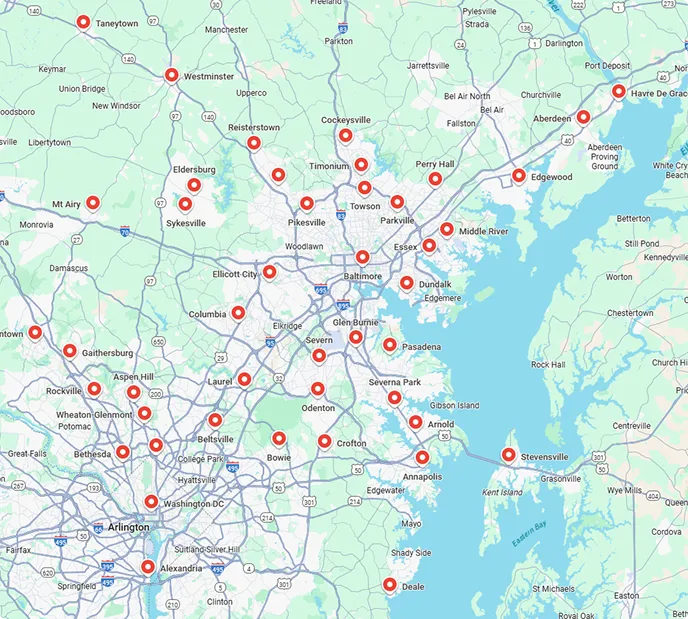
Service areas